Theatre (deaf-centered) [Final project]
The Milan Congress Declares Oralism as Superior to Sign Language
The Milan Convention’s ban on sign language pushed oralism, cuffing ASL. The ban stifled Deaf creative expression, affecting Deaf theater in the process. The Deaf community doesn’t stop, preserving ASL and continuing to create art in secret. Through grassroot works, Deaf theater continues and paves a legacy.
Keywords
Ban, Oralism, Perseverance, ASL, Sign Language, Expression
Sources
Berke. Jamie “The Milan Conference of 1880: Impact on Deaf Education and Culture.” Verywell Health. Last modified June 16, 2023. https://www.verywellhealth.com/deaf-history-milan-1880-1046547.
Hodges, Montana. “Theater in the Deaf Community,” Lifeprint, accessed January 27, 2025, https://www.lifeprint.com/asl101/topics/theater.htm.
Gallaudet University showcases early play productions, adapting a selection from the Shakespearean Classic: Julius Caesar
Sources
Lifson, Amy. “Shakespeare in the Sign,” National Endowment for the Humanities, accessed January 25, 2025, https://www.neh.gov/article/shakespeare-sign.
National Association of the Deaf’s ASL films Against the Oralist Movement
The NAD begins compiling a selection of films in the 1910s, preserving a legacy of the master signers. Fearing erasure at the hands of Oralist supremacy, the NAD hopes for these films to extend a hand to a future generation. Selections from these films showcase powerhouse figures in early American Deaf history, George Veditz being one such man.
Keywords
Preservation, Oralism, Future, NAD, ASL, Film
Sources
National Association of the Deaf. “Historic NAD Film Selected for Preservation by Library of Congress.” Last modified December 28, 2010. 1910
Live entertainment falls out of favor with the mainstream as the rise of movie theaters and television brings a new level of convenience to America.
Sources
PBS. “The Rise and Fall of Vaudeville.” American Masters. Accessed January 2025. https://www.pbs.org/wnet/americanmasters/vaudeville-about-vaudeville/721/.
Gallaudet College Dramatic Club perform “Arsenic and Old Lace” on Broadway
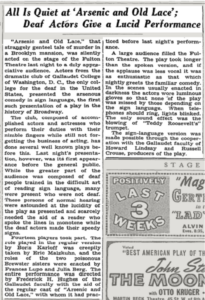
Gallaudet students make history with the first deaf performance on Broadway. Deaf and hearing audience members alike fill the Fulton Theater. The hearing interpreter with spoken lines is almost unneeded due to the clarity of the deaf actors in their signing. This performance is groundbreaking. These students are ahead of their time, pioneering a path for groups such as the National Theatre of the Deaf to be established decades later.
Image: The original news column detailing the happening of the performance. A grand milestone for the Deaf community.
Keywords
Broadway, Groundbreaking, History, Deaf Theater, Gallaudet
Sources
“All Is Quiet at ‘Arsenic and Old Lace’”, New York Times, May 11, 1942, https://www.nytimes.com/1942/05/11/archives/all-is-quiet-at-arsenic-and-old-lace-deaf-actors-give-a-lucid.html?unlocked_article_code=1.sU4.vwN8.DD0Yit7Q8i2D&smid=url-share
The Oralism period falls out of favor in recognition of Sign Language in the 1960s
Sources
Kuurojen Museo (Museum of the Deaf). “Oralism in the Education of the Deaf.” Accessed January 2025. http://www.kuurojenmuseo.fi/?p=720&lang=en#
The National Theater of the Deaf is formed and begins touring in 1967
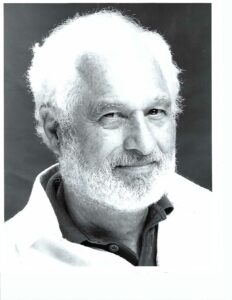
David Hays, as one the founding directors of the NTD, envisions a new form of acting in theater. He innovates a new style that incorporates both the deaf and the hearing, while championing the Deaf.
Image: A black and white portrait photo of David Hays, founding artistic director of the NAD. He is wearing a white shirt over a darker polo shirt. His white hair seems to glow due to the overexposure of the camera. He smiles warmly, making eye contact with the camera.
Sources
National Theatre of the Deaf. “About Us.” Accessed January 2025. https://ntd.org/about-us/.
National Theatre of the Deaf. “David Hays, Betty Beekman, and NTD Founders Receive Awards.” Accessed January 2025. https://ntd.org/david-hays-betty-beekman-and-ntd-founders-receive-awards/.
Eliot Norton interview with members of the National Theatre for the Deaf.
This episode of Eliot Norton Reviews highlights the professional deaf theater experience. The actors explain that deaf children must put effort into their communication, much like acting, making them “natural born actors”. The members also explain that ASL can be just as specific and descriptive as spoken word. Their shows leave nothing behind through the translation to sign. This interview importantly reveals the perspective and capabilities of deaf performers to the general population.
Keywords
Keywords: Deaf Theater, ASL, Deaf Children, Interview
Sources
National Theatre of the Deaf. Anonymous WGBH Boston, 1977. https://video.alexanderstreet.com/watch/national-theatre-of-the-deaf.
Deaf West Theatre is founded in 1991, paving the way for new generation actors as the century transitions into a new era.
Sources
Deaf West Theatre. “About.” Accessed January 2025. https://www.deafwest.org/about/.