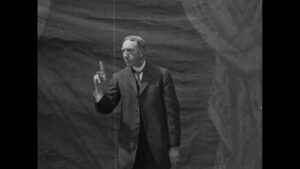
Peers at Gallaudet, Edmund Booth, Edwin Hodgson, and Robert P. McGregor, found the NAD in 1880. Through initiatives like their film campaign to preserve sign language, the NAD defends deaf liberties. Their convention’s conversations fight for deaf agency in society like reproductive rights amid the growing influence of eugenics. The NAD exemplifies deaf resistance and leadership.
Image Description: Black and white image depicts George Veditz, 7th president of the NAD, fiercely advocating for deaf people’s right to use sign language with precise and bold signing in a film. Veditz is well-dressed in typical Edwardian fashion, indicating the time period of the film. His expression is stern, demonstrating his intent to have an emotional impact on the audience.
NAD, deaf rights, oralism, eugenics, connections and conflicts
In Our Own Hands: Essays in Deaf History 1780-1970, Brian Greenwald and Joseph Murray, eds.
(Washington DC: Gallaudet University Press, 2016) pp 171-193; S. J. Wright
Burch, “Visibly Different: Sign language and the deaf community,” Signs of Resistance.
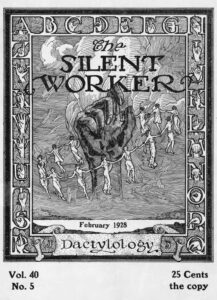
Deaf editor George Porter publishes The Silent Worker, a newspaper highlighting the accomplishments of deaf men and women worldwide. It targets both a deaf and hearing audience, encouraging deaf community collaboration and opposing restrictive images of deaf workers worldwide. While the paper shows evidence of racism, sexism, and ableism, the printing of the Worker remains an event of significance, demonstrating the competence and ambition of the deaf community to an international audience.
Image Description: Black and white printed cover of the February 1928 edition of deaf newspaper The Silent Worker. The image portrays a larger-than-life loosely held fist surrounded by a circle of people holding hands and appearing to “dance” around the upraised fist. The magazine itself is bordered by letters of the alphabet, each letter superimposed with its ASL sign. A banner at the bottom of the cover reads “Dactylology,” another term for finger spelling. The dedication of the February 1928 issue of The Silent Worker to Dactylology conveys the importance of ASL for the deaf community, as well as demonstrating the pride the deaf writers and editors of the Worker held in their community’s manual language.
George Porter, The Silent Worker, New Jersey School for the Deaf, deaf community, connections, racism, sexism, ableism
Robert Buchanan, “The Silent Worker Newspaper and the Building of a Deaf Community: 1890-1929,” In Deaf History Unveiled (Washington, DC: Gallaudet University Press, 1993), 175-178.
Kincheloe, Pamela J. “The Hand of The Silent Worker: Reading an ASL Imageword.” Disability Studies Quarterly, 2016. https://ojs.library.osu.edu/index.php/dsq/article/view/4499/4311.
The newspaper’s publications primarily concern portraying deaf people as fully functioning Americans. The paper promotes vocational training for deaf students to showcase their wage-earning capacity. Feeding deaf students into manual labor jobs sustains employability yet limits earning potential and social mobility. The periodical maintains manual labor as one of few viable paths to social legitimacy. Writers avoid politically controversial deaf role models and stories. To assert American morality, the paper rejects communist associations by retitling.
vocational training, social mobility, American morals, limitations
Terry Easton, “Identity and Politics in the Silent Worker Newspaper: Print Publication and the Laboring Deaf Body” Women’s Studies Quarterly 26, 1 (Spring 1998), 57-71.
Columbia Institution for the Deaf instructor May Martin criticizes prejudiced employers and oralism’s harmful impacts in her National Association of the Deaf address in St. Paul, Minnesota. Highlighting access challenges deaf women especially face in education and industrial employment, she proposes strategies to counter sexism and oralism while reinforcing white, middle-class norms.
labor; gender; oralism; audism; NAD; sexism
Robert M. Buchanan, Illusions of Equality: Deaf Americans in School and Factory, 1850-1950. (Gallaudet University Press, 1999), 71.
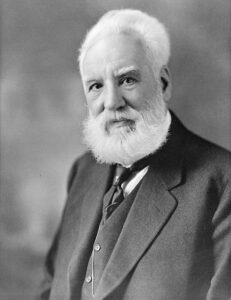
Bell, a known opponent of deaf-deaf marriage, publishes an article for the deaf and hearing masses. The article contains his thoughts on marriage restricting legislation amongst the deaf. He believes marriage is a personal choice that cannot be controlled through legislation. He instead wants to educate the deaf into choosing hearing partners. This is an important statement to protect the deaf population from forced sterilization and loss of marriage rights.
Eugenics; sterilization; deaf marriage; legislation; marriage rights; conflict
Melissa Malzkuhn, “Compromising for Agency” (2016, Gallaudet University Press), pp. 179-182
Gaillard highlights Jewish Deaf community solidarity in New York. He reveals the persisting oral versus manual education debates and challenges with diverse needs. The Jewish Deaf Community strengthens in spirit against on-setting dangers as America enters the world war and new social developments affect Deaf progress.
solidarity, war, social progress
Gaillard, Henri. Gaillard in Deaf America: A Portrait of the Deaf Community, 1917. Volume 3 of Gallaudet Classics in Deaf Studies. Edited by Gerard Buckley. Washington, DC: Gallaudet University Press, 2003.
Burch, Susan. 2009. Encyclopedia of American Disability History / Edited by Susan Burch ; Foreword by Paul K. Longmore. New York: Facts On File.
Deaf writer Warren Milton Smaltz’s “Fable” is a satirical criticism of oralist ideologies. The Fable uses the metaphor of an “ass” (deaf person) failing to learn to “whinny” (speak) by a society of “horses” (hearing people) while forgetting to “bray” (sign). Eventually, he is isolated from both communities. The “Fable” is an example of deaf rebellion, showing how critiques of oralism aim to influence both deaf and hearing readers to support sign language.
The Silent Worker, Warren Milton Smaltz, oralism, deaf rebellion
Warren Smaltz, “The Fable of the Ass Who Was Taught to Whinny,” In The Silent Worker, 5.
Robert Buchanan, “The Silent Worker Newspaper and the Building of a Deaf Community: 1890-1929,” In Deaf History Unveiled (Washington, DC: Gallaudet University Press, 1993), 186.
Porter and the Worker staff publicly oppose the New Jersey School for the Deaf’s oralist Superintendent Alvin Pope by publishing criticisms of his teaching methods. As a result of this clash of pedagogical differences, Pope censors the content of the Worker, yet writers continue to use the paper to make subtle political statements. Ultimately, Pope orders the end of production for the Worker in a striking example of discrimination against the development of deaf community.
George Porter, The Silent Worker, Alvin Pope, New Jersey School for the Deaf, censorship, deaf community, conflicts
Robert Buchanan, “The Silent Worker Newspaper and the Building of a Deaf Community: 1890-1929,” In Deaf History Unveiled (Washington, DC: Gallaudet University Press, 1993), 186-188.
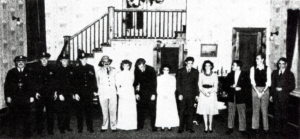
At Fulton Theatre in New York, Arsenic and Old Lace’s producers invite Gallaudet College’s student dramatic club to perform the play’s sign language version. This is the first public play in sign by deaf performers, bringing sign language to mainstream theatre. This production catalyzes the 1967 founding of the National Theatre of the Deaf, a continued key source of deaf talent in theatre, television, and film.
The photograph, courtesy of Richard Mullins, captures the original cast of Arsenic and Old Lace from Gallaudet University’s student dramatic club taking a curtain bow on May 2, 1942, in Chapel Hall. Taken just days before their groundbreaking Broadway performance, this image documents the historic cast and symbolizes a milestone in deaf theatre.
Fulton Theatre, Arsenic and Old Lace, Gallaudet College, Broadway, deaf performers, sign language, mainstream, theatre
“Arsenic and Old Lace | Gallaudet University.” Gallaudet University. https://gallaudet.edu/museum/exhibits/gallaudet-at-150-and-beyond-exhibit/arsenic-and-old-lace/
John S. Schuchman, “Silent Movies and the Deaf Community,” Journal of Popular Culture 17, No. 4 (Spring 1984). P. 73-4.
Stephen C. Baldwin. “Arsenic and Old Lace: A Signed Production That Went Ahead of its Time,” The Voice, Nov/Dec 1989, p. 20-22.

caption:
America refuses to acknowledge Black Deaf schools in its history. The American Veterans Committee is working to shed light on the inequality present. Louise Miller and a group of enraged parents are here to help. These individuals file a class action lawsuit against the D.C. Board of Education. The court ruled the school district must provide equal educational facilities for deaf children of all races.
Picture caption:
This is a letter from the D.C. Board of Education to Louise Miller. The letter explains the segregation present in schools and why Black Deaf students can not attend the same schools and white deaf students. This letter sparked Mrs. Miller’s fight for equal education for all deaf students–regardless of color.
Equality, American Veterans Committee, Class Action Lawsuit, Segregation
Caption cites:
“Class of ’52.” Class Of ’52, dcmp.org/media/6393-class-of-52. Accessed 21 Jan. 2025.
Glenn B. Anderson And Lindsay M. Dunn, “Assessing Black Deaf History: 1980s to the Present,” Sign Language Studies 17, no. 1 (Fall 2016): 75
“History of the Necessity of Now.” Gallaudet University, 1 July 2024, gallaudet.edu/history-necessity-of-now/#miller-v-d-c-board-of-education.
Picture cite:
“History of the Necessity of Now.” Gallaudet University, 1 July 2024, gallaudet.edu/history-necessity-of-now/#miller-v-d-c-board-of-education.

Andrew Foster, a hearing-impaired African-American missionary, opens the Ibadan Mission School for the Deaf. Later, the school combines with a Home for the Deaf to form the Ibadan School. Deaf Nigerians experience significant audist discrimination, thus the school provides a safe place to learn vocational skills, academics, and communication. After graduating, many students attend universities and Technical Colleges. Deaf individuals, previously rejected by society, now play an important role in the workforce and society.
Photo: School seal of the Ibadan School for the Deaf. Provides knowledge and hope to the deaf community in Nigeria.
education, deaf Nigeria, vocational training, American Sign Language
Alaade, Eunice B. “Development of Education of the Hearing Impaired in Nigeria” (Special Education Unit, Educational Psychology Department, Kenyatta University). pp 107-113.
Rashid, Khadijat. “Intersecting Reflections,” Deaf and Disability Studies: Interdisciplinary Perspectives (Gallaudet University Press, 2010). pp. 22-30. p. 23.
Facebook. https://www.facebook.com/CMDNigeria/ image. Accessed 16 Jan 2025.
Glenn Anderson and Frank Bowe, deaf authors, discuss the effects of racism on the deaf community and the unmet needs of the black deaf population. Racism is a significant issue in the hearing community that reflects many problems in deaf communities. These issues include educational and personal developmental effects on minority children and lack of integration of all people. Minority populations in the deaf community face racism and ableism within the deaf and hearing communities.
racism, discrimination, education, children
Anderson, Glenn B. & Bowe, Frank G. “Racism within the Deaf Community,” Deaf World: A Historical Reader and Primary Sourcebook (New York University Press, 1972). pp 305-308.
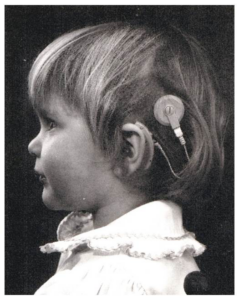
Cochlear implants invention, and subsequent FDA approval, drives mainstream America’s obsession with curing deafness and speaking. Many in the deaf community, including the NAD, resist this to preserve ASL and the autonomy of deaf children; showing conflict between the hearing world and deaf world. The debate over CI’s extends within the deaf community. Many deaf elites ostracize members of the deaf community with CI’s – showing internal conflict.
The image illustrates the invasive nature of a cochlear implant: both a piece behind the ear and one that directly connects to the patient’s head. The invasive nature of the implant, along with the threat to ASL, causes deaf community’s animosity, while the promise of hearing drives the hearing world’s push for CI’s.
Cochlear Implant (CI), ASL, Oralism, Deafness, NAD, FDA, Cochlear Corporation, Audism
Jaipreet Virdi, “Epilogue: Beyond the Eyes of Incredulity,” in Hearing Happiness: Deafness Cures in History (Chicago: University of Chicago Press, 2020), 247-267.
Dr. Brian Kulbersh. (2020). Expert Pediatric Doctors Discuss the History of Cochlear Implants. Pediatric ENT Associates. https://www.pediatricentassociates.com/expert-pediatric-ent-doctors-discuss-the-history-of-cochlear-implants/#:~:text=1990%20–%20The%20FDA%20approved%20the,children%20at%2012%20months%20old .
MED-EL .(2024). Pioneers, Passion, and Perseverance – the History of Cochlear Implants. Hearpeers. https://hearpeers.medel.com/en/learn/hearing-solutions/pioneers-passion-and-perserverance-the-history-of-cochlear-implants

Section 504 outlaws discrimination based upon disability. Protesters occupy San Francisco’s Health and Wellness (HEW) building, demonstrating how unified activism fosters change. While disability groups came together for this battle, the deaf community continues to differentiate themselves, leveraging ableism in hopes of securing more inclusion as compared to other disability groups. The United States was experiencing a surge of activism movements, and the disability rights movement emerged powerfully within this wave of social change.
The title of this newspaper headline underscores the significant stakes involved in the 504 protests. While the title is a metaphor, it highlights how these protests were “war” like as disability activists were fighting with a warlike mindset: not giving up until they see the change they want.
Activism, Protest, San Francisco, Rehabilitation Act of 1973, 504 Regulations, Deaf Community, Rehabilitation Act of 1973
Disability Rights Education & Defense Fund, dir. The Power of 504. 2008.
AMST 360 U.S. DRM and DJ Histories Class Discussions, Dr. B, Fall Semester

This black-and-white image shows a large group of people, many of whom are in wheelchairs, gathered in a room of the HEW building in San Francisco. It is the 504 Sit-In. Protesters surround a standing female who is signing. Many of the attendees are focused; others are interacting with those around them. A cameraman is in the back of the image with a large camera.
The Section 504 Sit-In unites deaf and disabled activists, forging unprecedented connections. American Sign Language (ASL) serves as a critical tool for communication, media outreach, and solidarity among protestors. Deaf activists’ contributions were pivotal in securing the passage of the 504 regulations, highlighting the Sit-In’s vital role in fostering solidarity and furthering disability rights.
Unity, Inclusion, Advocacy, Protest, The 1973 Rehabilitation Act, Section-504, American Sign Language (ASL)
Disability Rights Florida. “Disability History: The 1977 504 Sit-In.” Disability Rights Florida. Accessed January 16, 2025. https://disabilityrightsflorida.org/blog/entry/504-sit-in-history.
Corbett O’Toole, “Dale Dahl and Judy Heumann: Deaf Man, Disabled Woman—Allies in 1970s Berkeley,” Deaf and Disability Studies, 171-174
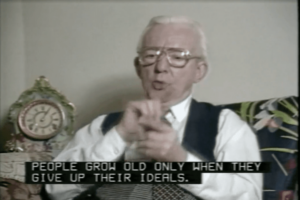
The 1977 documentary Moving Picture, Moving Hands: The Story of Ernest Marshall explores Ernest Marshall’s life, work, and legacy, following the decline of the Silent Film Era. His groundbreaking 1937 feature, It Is Too Late, is the first feature film in ASL. Marshall continues to produce films centered on deaf storytelling, embarking on national tours to showcase his work. Through these efforts, he strengthens cultural connections within deaf communities.
Image description: This image captures an elderly Ernest Marshall during an interview shown in the colored documentary, signing expressively as he reflects on his life’s work and legacy. The caption at the bottom, “PEOPLE GROW OLD ONLY WHEN THEY GIVE UP THEIR IDEALS,” highlights Marshall’s enduring belief in the power of ideals and creativity. This moment underscores his commitment to fostering connection of deaf communities through his films and introducing deaf-centered storytelling to the mainstream.
Ernest Marshall, Silent Film Era, ASL, feature films, storytelling
Bangs, Don, and David Jarashow, dirs. 1977. “Moving Pictures, Moving Hands: The Story of Ernest Marshall.” https://media.gallaudet.edu/media/Moving+Pictures%2C+Moving+HandsA++The+Story+of+Ernest+Marshall/1_9enr1u7k.

Caption: Members of the Deaf, Black community often feel alienated. Ernest Hairston and Linwood Smith publish a book highlighting “Black ASL.” Black, Deaf individuals sign slightly differently. Hairston’s and Smith’s work provides a deeper appreciation for their differences. The creation of the NBDA shortly follows the publication. NBDA meetings focus on achieving equality and empowerment for Deaf minorities. The Black, Deaf community’s rights and history is being protected.
Picture:
The first NBDA meeting held at Howard University in 1981. Nearly one-hundred Black Deaf individuals present. The conference successfully discussed the workplace, education, and religious issues. The photo marks a milestone in the progression towards deaf equality.
“Black ASL” , Empowerment, Rights , Renaissance , NBDA (National Black Deaf Advocates)
Caption:
Burch, Susan. “2. Visibly Different: Sign Language and the Deaf Community”. Signs of Resistance: American Deaf Cultural History, 1900 to World War II, New York, USA: New York University Press, 2002, pp. 52.
Glenn B. Anderson And Lindsay M. Dunn, “Assessing Black Deaf History: 1980s to the Present,” Sign Language Studies 17, no. 1 (Fall 2016): 71-77
Picture:
www.nbda.org/history/
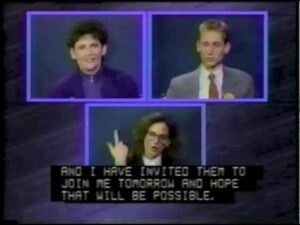
Ted Koppel’s Nightline interview highlights tensions between Deaf and hearing worlds during the DPN protest. Gallaudet student body president Greg Hlibok and actress Marlee Matlin express frustration with Gallaudet and the board, while president-elect Dr. Elizabeth Zinser shares her refusal to resign despite lacking Deaf knowledge. The segment exhibits the importance of Deaf people making the decisions that affect Deaf people. Nationally captioned, it informs hearing audiences about Gallaudet’s significance and challenges perceptions of Deaf individuals’ capability.
Image Description:
Three individuals are shown on a video screen with each person in one box. The person on the top left box is Dr. Elizebth Zinser, a feminine individual with light skin and short, dark hair. They are wearing a purple blouse with a purple coat. They are looking at the camera with a soft smile. In the top right box is Gregory Hlibok, student body president of Gallaudet University at the time. They appear to present themselves masculinely, with buzzed blonde hair and wearing a white button-down, red necktie, and gray sportscoat. Their eyes are closed in this image, but their body faces the camera. In the bottom box is Marlee Matlin, who appears feminine, has shoulder-length brown hair and glasses, and is wearing a white blouse beneath a black blazer. They are pointing up with their left hand and their left thumb extended. Captions at the bottom read: “And I have invited them to join me tomorrow and hope that will be possible.”
Deaf representation, DPN, protests, interviews, broadcast, news, deaf, non-deaf "Nightline Special Interview." ABC. March 9, 1988. Video, https://www.youtube.com/watch?v=jxLC0_qTYVw.
“Nightline Special Interview.” ABC. March 9, 1988. Video, https://www.youtube.com/watch?v=jxLC0_qTYVw.
Description of Primary Source
This 2004 paper is by Tanis Doe, academic and disabilities rights activist from Victoria, British Columbia, Canada. Doe argues against Deaf culture’s ableist foundations and resistance to the term “disabled.” The work primarily calls upon the Deaf community for acceptance but also applies to hearing and disabled people.
Caption:
Disability Studies professor, Tanis Doe, shares her experience being excluded from Deaf world as a Disabled person. She explains that Deaf people view themselves as linguistically separate from the Disabled. Doe asserts that Deaf world’s conflict with the Disabled community highlights the influence of ableism. She writes at a critical time for Disabled rights, (e.g. Tennessee vs Lane, AT Act 2004) and calls for unity between Deaf and Disabled communities for increased political power.
Deaf vs. deaf, disability, stigmatization, ableism, civil rights, marginalization
“Tanis Doe Award,” Canadian Disabilities Association, https://cdsa-aceh.ca/awards/tanis-doe-award/
Tanis Doe, “The Difficulty with Deafness Discourse and Disability Culture,” Review of Disability Studies: An International Journal 1, no. 1 (2004) pg 1-7
“Chronology.” Encyclopedia of American Disability History, edited by Susan Burch, Facts on File, 2009, pp. xxiv-lvi. Facts on File Library of American History. Gale eBooks, link.gale.com/apps/doc/CX1698300012/GVRL?u=vol_m58c&sid=bookmark-GVRL&xid=4b4987a8. Accessed 23 Jan. 2025.
Educator and activist Tanis Doe details her experience as a deaf and disabled person. She highlights “D” deaf culture rejection of disability categorization. Many deaf people prefer linguistic minority classification. Discussing several potential reasons for disassociation, Doe posits ableism plagues deaf worlds as much as hearing ones. Doe hopes “D” deaf people will recognize disability culture and pride. Neither deaf nor disabled people desire recognition as “broken.”
minority, disability, ableism, community, pride
“Tanis Doe Award,” (Canadian Disability Studies Association-Association canadienne d’études sur le handicap); https://cdsa-aceh.ca/awards/tanis-doe-award/
Tanis Doe, “The Difficulty with Deafness Discourse and Disability Culture,” (British Columbia, Canada: Royal Roads University and University of Victoria, 2004), 2-7.
John B. Christiansen, a Gallaudet educator and selection committee member, describes the protest against president-elect Dr. Jane Fernandes, a white Deaf woman and former provost. Protesters criticize the lack of diversity in the search and question Fernandes’ authenticity as “Deaf enough”. The protest, echoing the 1988 Deaf President Now movement, highlights concerns about the decline of residential schools and therefore Deaf culture, exposing deep tensions within the Deaf community over leadership and cultural representation.
Gallaudet University, protest, Deaf culture, Dr. Jane Fernandes, connections, conflict, within, deaf world
John B. Christiansen, “The 2006 Protest at Gallaudet University: Reflections and Explanations.” Sign Language Studies 10, no. 1 (Fall, 2009): 69-89,134.
The Coalition advocates for bilingual education in ASL and written English, supporting cognitive and academic growth in Deaf children. By promoting ASL as an educational foundation, the coalition strengthens ties within the Deaf community while connecting children to broader American culture through written English. This formation is a culmination of 20th-century movements to preserve ASL and challenge audism, emphasizing the importance of both languages in education.
The image is the Deaf Bilingual Coalition’s Logo. It states the name of the organization and brief mission as Deaf Children’s Advocates. To the right side it has the ASL symbol of link or connection. This represents the connection and importance of teaching both ASL and written English.
Bilingual, Audism, Education, Connection
Kristen Harmon, “Deaf Matters,” in Deaf and Disability Studies: Interdisciplinary Perspectives (Gallaudet University Press, 2010)
Owlcation. (n.d.). 21 basic sign language signs you probably already know. Owlcation. https://owlcation.com/humanities/21-Basic-Sign-Language-You-Probably-Already-Know
Dallas Baptist University. (n.d.). About us. Dallas Baptist University. https://www.dbcusa.org/about-us/
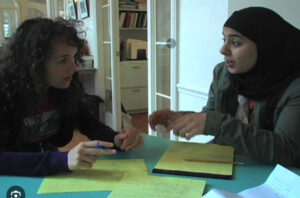
Two girls. Two different cultures. Two different languages. They bridge differences through slam poetry. They connect a hearing and deaf individual through ASL. Their work earns recognition from Gallaudet and Columbia Universities. The internet fosters opportunities for connection and change. Civil rights activism grounds and inspires them. Demonstrating language survival is vital to identity. Celebrating Deaf cultural autonomy and recognition through change.
This image demonstrates how the hearing and deaf worlds transcend barriers. Initially unable to communicate or understand each other’s stories, they persevere, crafting heartfelt poems that unite both perspectives. The portrayals of two girls surpasses political, economic, and cultural divides. Showcasing how slam poetry beautifully bridges their unique expressions and viewpoints.
Language, Connection, Opportunity, Activism
New Day Films, director. Deaf Jam. Kanopy, 2013, Accessed 16 Jan. 2025.
Burch, Susan. “Conclusion: The Irony of Acculturation Continued.” Signs of Resistance, New York University Press, 2002, pp. 168–174.
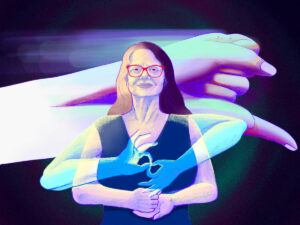
Drawing on life experiments, deaf professor at Gallaudet University Dr. Teresa Blankmeyer Burke writes deaf is not a deficit. Similar displays of deaf empowerment are seen on Nickelodeon’s, “Now Hear This” in 2014, emphasizing Deaf Gain. She discusses the differences between culturally Hearing/Deaf and audiologically hearing/deaf, showing different cultural and audiological perceptions of deaf.
The image displays Dr. Teresa Blankmeyer Burke within hands showing sign language, displaying the importance of sign language to the deaf community and her own personal experiment. ASL deeply connects to Deaf culture, which distinguishes it from the hearing world. The bright colors bring attention to the sign language, showing viewers the critical importance of ASL.
Deaf Gain, Audiological, Socio-linguistic, Deaf v deaf, Human Diversity, Philosophy, Cultural
Dr. Teresa Blankmeyer Burke. (2021). Publication. WordPress. https://teresablankmeyerburke.net/publications-3/
Dr. Teresa B. Burke. “Armchairs and Stares: On the Privation of Deafness” in Deaf Gain: Reimagining Human Diversity. (Minnesota: University of Minnesota Press, 2014), 3-20.
Lydia Callis. (2014). 2014: Deaf Culture Totally Had a Moment. SignNexus. https://www.signlanguagenyc.com/2014-deaf-culture-totally-moment/
image: George Yancy. (2024). What Can Deaf Philosophy Teach the World – and How Will It Change It?.truthout. https://truthout.org/articles/what-can-deaf-philosophy-teach-the-world-and-how-will-it-change-it/
Cuban-deaf Angela feels she is losing her connection to Hispanic culture for deaf culture. In childhood, her family focused on teaching her ASL and not Spanish. Intersectionality now creates a communication barrier. This complicates community integration and catalyzes isolation. Communication reaps community and promotion of dual identity can be best. Angela exemplifies this through teaching her son both languages, defying cultural assimilation.
Deaf, Hispanic, Identity, Assimilation, Communication, Community
“Being Deaf and Latino,” NPR [no transcript available]
An NPR video explores the divide within deaf community. The debate centers on cochlear implants versus sign language. Cochlear implant surgery is invasive and divides perspectives. It raises questions about communication, identity, and societal expectations. What defines being deaf? How does society shape this identity? The film examines these cultural intersections. It sheds light on struggles within the deaf community. It also explores their relationship to mainstream norms.
Value, Knowledge, Family, Understanding
“Through Deaf Eyes.” Public Broadcasting Service (PBS).
NPR, director. A Few Things to Know About American Sign Language. Youtube, 15 Apr. 2017, https://youtu.be/wa0nxppMJ-Q?si=qwFCGlmA0Z3k-y-r. Accessed 20 Jan. 2025.
Black deafs reveal the heavy weight of their socio-economic status. Chaotic environments and lack of necessities endured, adds strain to defy racist stereotypes. This creates a gap between deaf children of different races. Through a disadvantaged lens, Black Deafs feel limited in their pursuit for success. The hearing world imposes on them. They communicate their qualms, yet realize that human connection is sadly chosen, not gained.
Black, Deaf, Racism, Impose, Communication, Connection
Glenn Anderson and Frank Bowe, “Racism within the Deaf Community” (1972)
“Statement on Racism and Oppression.” National Deaf Center, 17 Jan. 2023, nationaldeafcenter.org/news-items/statement-racism-and-oppression/.
In a short video from NPR, people share their thoughts on ASL. It bridges cultures and communities. It highlights connection through diverse styles like black ASL and other accents. It’s a distinct language with unique grammar, not just English in sign form. Understanding these differences helps foster respect and connection while avoiding conflict. Like using “deaf” and not “hearing impaired”, or understanding that speaking does not mean a lack of deafness.
Accents, Influence, Word order, Culture, Community
“A Few Things to Know About American Sign Language” NPR video (2017)
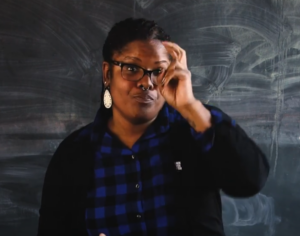
NPR’s video highlights deaf speakers, introducing ASL to a broader audience. The speakers explain the connections between English regional accents and ASL, as well as how ASL differs from English with its own grammatical rules. This emphasizes ASL’s legitimacy to hearing viewers while addressing tensions between deaf and hearing people, particularly by correcting derogatory terms like “hearing impaired.” By highlighting that deaf people are not disabled, the video challenges the American stigmatization of deafness.
Image Description: A black woman seated in front of a chalk board brings two fingers towards her forehead showing a the sign for “you tripping.” This piece of African American Vernacular English translated into sign reflects how ASL integrates into broader American trends.
Black ASL, Accent, Grammar, Connection, Conflict
NPR (Director). (2017, April 15). A Few Things to Know About American Sign Language | NPR [Video recording]. https://www.youtube.com/watch?v=wa0nxppMJ-Q
Deaf and disability studies: Interdisciplinary perspectives (2010). In Burch S., Kafer A.(Eds.) (pp. 60-76). . District of Columbia: Gallaudet University Press. Retrieved from https://search.alexanderstreet.com/view/work/bibliographic_entity|bibliographic_details|3292380