Science, Medicine, Technology [final project]
The First Electronic Stimulation of the Ear and the First Discoveries of Cochlear Implants
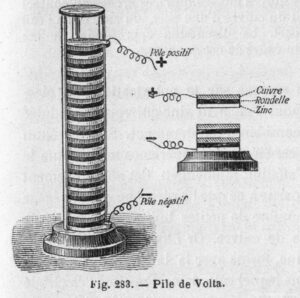
Hearing physicist and chemist, Alessandro Volta, shocks his ear canals using a battery connected to two metal rods. He hears a crackling sound and believes he has successfully electrically stimulated his ear. Fifty years later, a hearing French neurologist, Duchenne de Boulogne, utilizes the same system but with alternating shocks. These technological advancements aid in the creation of cochlear implants; a physically invasive tool, known as a deafness cure.
Image Caption: The battery with two metal wires used by Alessandro Volta. This invention allows scientists to eventually create the cochlear implant. Volta discovers that stimulating the cochlea, part of the inner ear, produces auditory sensations.
Keywords
cochlear implant, technological advancement, cure
Sources
Hainarosie, Razvan, “The Evolution of Cochlear Implant Technology and its Clinical Relevance.” (Journal of Medicine and Life, 2014). pp 1-4.
“International Battery Day: Celebrating the Birth of the Battery.” EPBA Europe, February 9, 2024. https://www.epbaeurope.net/news/international-battery-day-celebrating-the-birth-of-the-battery.
Charles Darwin’s Origin of Species publication becomes a source for the oralist generation to abuse

English naturalist Charles Darwin introduces the theory of evolution. He shares how sign language is a “primitive and infant way of thinking”. As a result, assimilation occurred in schools – banning signs. Thus, teaching deaf children to speak and lip-read. This reflects the evolutionary biases held by those with greater societal status.
Keywords
evolution, primitive, banned, oralist, assimilation, biases
Sources
Douglas Baynton, “Savages and Deaf-Mutes: Evolutionary Theory and the Campaign against Sign Language,” Journal Anthropological Study of Human Movement 8, no. 4 (1995): 139-72
The Invention of the Audiometer and Research at Schools for the Deaf
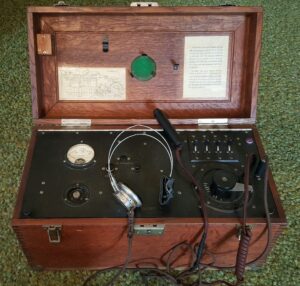
An audiometer tests the extent of hearing based on tonal frequencies (pictured here). Rudolph Pinter, Herbert Day, and Irving Fisfield, educational specialists, research the speech abilities of residential and oralist day school students using audiometers. The study concludes that the age of deafness, degree of hearing loss, and length of speech training affect speech abilities. The data showcases the limitations of oralism; however, many oralism supporters ignore these conclusions.
Keywords
scientific discovery, audiometer, technology
Sources
Burch, Susan. “The Irony of Acculturation,” Signs of Resistance, (New York University Press, 2002), 7-41. Pg 33.
From Mechanical to Electronic Hearing Aids

Hearing aids are a prominent deaf aiding device dating back to the late 17th century. Post-World War II drives technological advances as the wearer can select amplified frequencies to fit the user’s preference. Upgrades in design now result in an entire fit of one’s ear. The stigma of deafness results in the popularity of purchases. From mechanical to electrical, the device provides a “solution” to integrate the deaf world into the hearing one.
Image Caption: A woman from the 20th century has a display of hearing aids throughout the century. It exhibits the progression from the ear trumpet (a big device) to an electronic hearing instrument (a smaller device). Representing the time period, Post-World War II led to production of hearing aids with circuit boards and button-sized batteries, allowing the batteries, amplifier, and microphone to be combined into one portable device.
Keywords
device, electrical, frequencies, stigma, solution
Sources
“The History and Evolution of Hearing Aids.” Memphis Audiology, 25 Apr. 2023, memphisaudiology.com/the-history-of-hearing-aids-and-how-they-have-evolved-over-time/.
Mills, Mara. “Hearing Aids.” Encyclopedia of American Disability History, edited by Susan Burch, Facts on File, 2009, pp. 436-438. Facts on File Library of American History. Gale eBooks, link.gale.com/apps/doc/CX1698300341/GVRL?u=vol_m58c&sid=bookmark-GVRL&xid=b3f535e8.
The emergence of cochlear implants as a “cure” to deafness
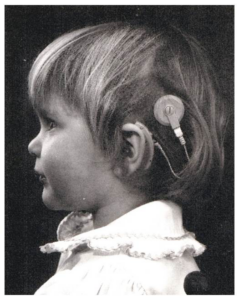
Cochlear implants invention, and subsequent FDA approval, drives mainstream America’s obsession with curing deafness and speaking. Many in the deaf community, including the NAD, resist this to preserve ASL and the autonomy of deaf children; showing conflict between the hearing world and deaf world. The debate over CI’s extends within the deaf community. Many deaf elites ostracize members of the deaf community with CI’s – showing internal conflict.
The image illustrates the invasive nature of a cochlear implant: both a piece behind the ear and one that directly connects to the patient’s head. The invasive nature of the implant, along with the threat to ASL, causes deaf community’s animosity, while the promise of hearing drives the hearing world’s push for CI’s.
[Credit to classmate who posted this caption on “Connections and Conflict”]
Keywords
cochlear implant (CI), ASL, oralism, deafness, NAD, FDA, Cochlear Corporation, audism
Sources
Jaipreet Virdi, “Epilogue: Beyond the Eyes of Incredulity,” in Hearing Happiness: Deafness Cures in History (Chicago: University of Chicago Press, 2020), 247-267.
Dr. Brian Kulbersh. (2020). Expert Pediatric Doctors Discuss the History of Cochlear Implants. Pediatric ENT Associates. https://www.pediatricentassociates.com/expert-pediatric-ent-doctors-discuss-the-history-of-cochlear-implants/#:~:text=1990%20–%20The%20FDA%20approved%20the,children%20at%2012%20months%20old .
MED-EL .(2024). Pioneers, Passion, and Perseverance – the History of Cochlear Implants. Hearpeers. https://hearpeers.medel.com/en/learn/hearing-solutions/pioneers-passion-and-perserverance-the-history-of-cochlear-implants
Dr. House and Dr. Doyle of Los Angeles Implant the First Cochlear Implant
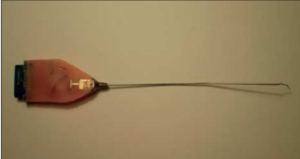
Image:
Prototype of House and Doyle’s cochlear implant. This is a single-channel device implanted in the round window of the ear. A round window is a small circular opening in the middle ear.
Keywords
cochlear implant, cure, technology
Sources
Mudry, Albert & Mills, Mara, “The Early History of the Cochlear Implant: A Retrospective.” (JAMA OTOLARYNGOL HEAD NECK SURG, 2013). pp 448.
Conversation about the Controversialness of “Deaf Cures”

Deaf historian, Japreet Virdi, researches deaf cures of the 19th to 21st centuries. Technology and surgery are remedies to this unwanted “medical condition.” The term “hard of hearing” (HoH) portrays a less negative connotation than being entirely deaf. Causing internalized stigmas within the deaf community. If one is HoH and their deafness is theoretically curable, they receive more praise by hearing society for their ability to come across as “normal.”
Image Caption: The cover of the book, Hearing Happiness, displays a woman wearing a bonnet tied under the chin and a fitted bodice with a high-collared blouse, which are indicative of 19th-century Victorian-era fashion. This style, particularly the bonnet, was popular among women in the mid-1800s and symbolized modesty and femininity. This woman in traditional Victorian attire holds an early hearing device, highlighting the centuries-long pursuit of a ‘miracle cure’ for deafness.
Keywords
history, conditions, stigmas, cures, technology, medical practices
Sources
Virdi, Jaipreet. “Hearing Happiness” Interview with Historian Jaipreet Virdi. Science Friday, 18 Sept. 2020, https://www.youtube.com/watch?v=BJWhpB0jMR0.
Virdi, Jaipreet. Hearing Happiness: Deafness Cures in History. Univ Of Chicago Press, 2022.
The First Deaf Woman Physician in the United States
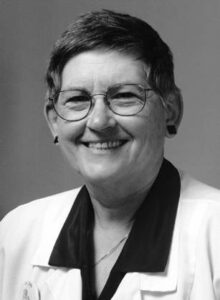
Dr. Pachciarz, pictured above, was discouraged from pursuing science throughout childhood. Many claimed her deafness would be a barrier. Yet, she earned a medical school acceptance. She holds an M.D. and Ph.D. in microbiology and immunology. Technological advancements including telecommunication devices and oscilloscope modifications let her “see” heart and lung sounds. She provides patients the same quality care as a hearing doctor. She is a role model, succeeding beyond the typical expectations of deaf world.
Keywords
doctor, technology, care, success
Sources
Turgeon, Jennifer. “Honoring National Deaf History Month.” Hooper Lundy & Bookman, 15 Apr. 2024, hooperlundy.com/honoring-national-deaf-history-month/.