Culture and Community
Origins Through the Long 19th Century
Brown set sail with emigrants seeking freedom to practice Protestant faith
Andrew Brown’s efforts in emigration suggests that some deaf people succeed in doing so and forms small communities afterwards, with engaging in religious activities becoming part of their culture.
Keywords
Emigration, Religious Practice, Community Forming
Sources
Harry Lang, “Genesis of a Community: The American Deaf Experience in the Seventeenth and Eighteenth Centuries,” Deaf History Reader, 3.
Revolutionary War
American Patriots fight to escape British rule and establish autonomous control over American colonies. Aided by France, the rebelling colonists achieve independence, but not without consequence: thousands of soldiers die in battle, and over twice as many die from disease. Many more are injured or disabled, including a significant number who become deaf due to artillery and disease. These deaf veterans return home from war with access barriers between them and their previous lives.
Keywords
Revolutionary War, Acquired Deafness
Sources
“Revolutionary War,” History.com, June 2024, https://www.history.com/topics/american-revolution/american-revolution-history.
“American Revolution Facts,” American Battlefield Trust, 2024, https://www.battlefields.org/learn/articles/american-revolution-faqs#:~:text=Throughout%20the%20course%20of%20the%20war%2C%20an%20estimated%206%2C800%20Americans,died%20while%20prisoners%20of%20war.
Harry Lang, “Genesis of a Community: The American Deaf Experience in the Seventeenth and Eighteenth Centuries,” essay, in Deaf History Reader, 1–23, 14.
Pennsylvania Magazine Publishes Manual Alphabet
ThePennsylvania Magazine publishes graphics of a two-handed manual alphabet called “Dumb Speech.” The magazine identifies some of the benefits of this manual alphabet as being quick to learn and capable of conveying thoughts and ideas faster than “even the most skillful artist can write…with pen and ink.” This publication is evidence that fingerspelling was used in colonial America by both hearing and deaf colonists, suggesting that deafness didn’t obstruct deaf individuals’ participation in society.
Keywords
Manual Alphabet, Sign Language, Colonial Deaf Experience
Sources
Harry Lang, “Genesis of a Community: The American Deaf Experience in the Seventeenth and Eighteenth Centuries,” essay, in Deaf History Reader, 1–23, 10.
The exemption of Joshua Graves during the Revolutionary War
The government exempts Joshua Graves from military duty due to his deafness. He then clears and plants acres of land to live. His experiences give insights on deaf lives during the Revolutionary War, in terms of military and regular life.
Keywords
Revolutionary War, Deaf Life
Sources
Harry Lang, “Genesis of a Community: The American Deaf Experience in the Seventeenth and Eighteenth Centuries,” Deaf History Reader, 13.
Opening of the American School for the Deaf
Thomas Gallaudet, with the assistance of Laurent Clerc, opens the school in Hartford, Connecticut as a place to teach both academic and vocational topics, along with sign language to deaf students as an outlet to communicate. The opening of school illuminates the importance of education to deaf culture and allows students to establish a strong community. However, the school excludes both women and Black students: highlighting prejudices commonly seen within deaf culture.
Keywords
American Sign Language, Sexism, Racism, Academic Training, Vocational Training
Sources
Robert Buchanan, “Building Independence,” Illusions of Equality, (Washington, DC: Gallaudet University Press, 1999), 1-19.
“The Mute’s Lament”

American deaf writer John Carlin, expresses an inferiority complex, internalizing the perspective of the hearing world. Reflecting other deaf author’s overshadowed pride, as the hearing world seeks to fix them to allow integration into society. Causing an overall battle between gratification and feeling inferior. Carlin speaks for himself in this poem but embodies the dilemma of the community trying to understand their value with the burden of the hearing world’s standards.
Keywords
Deaf double consciousness, author
Sources
Christopher Krentz, “A Sense of Two-ness: Deaf Double Consciousness at Midcentury,” in Writing Deafness (Chapel Hill: University of North Carolina Press, 2007), 137 -138.
Equal Futures
Debate emerges about the Deaf-Mute community’s future. Letters explore their placement and societal roles. Mr. Flournoy supports creating a separate community. Seeking to address marginalization created by education gaps. Change is attainable. Efforts highlight the community’s innate worth. Advocacy emphasizes equality and inclusion. Deaf individuals deserve recognition and opportunities. Society benefits when all contribute simultaneously.
Keywords
Community, class, communication
Sources
Booth, E., and J. J. Flournoy. “MR. FLOURNOY’S PLAN FOR A DEAF-MUTE COMMONWEALTH.” JSTOR – Persistent Links for Library Resources – Research Guides at University of Oregon Libraries, Jan. 1858, 40-45.
Deaf Commonwealth Letters
Due to prejudices, deaf American authors John Flournoy and Edmund Booth debate the best place for their community. Flournoy advocates for emigration; allowing sign to be taught and sovereignty. Booth finds it improbable due to illiteracy. This debate splits the community, their intelligence and ability to be educated is questioned, revealing the view the deaf have on their own people. Noting the effects of prejudice on the deaf which shapes their identity and aspirations.
Keywords
Identity, emigration
Sources
Flournoy, JJ. “On Planning a Deaf-Mute Commonwealth.” 1858. [and responses], pp. 13-26.
Susan B. Anthony and Matilda Joslyn Gage Present a "Declaration for the Rights of Women" to the Vice President
Women’s Rights Activists, Susan B. Anthony and Matilda Joslyn Gage disrupt the Centennial Celebration of the U.S. to challenge the exclusion of women from fundamental rights. Showcasing that a celebration for a country built upon liberty and justice does not include those ideals for women. This effort allowed for significant progression in the women’s suffrage movement.
Keywords
Women's rights, gender bias, equality
Sources
National Women’s History Museum. “Timeline of Woman Suffrage.” Women’s History. Accessed January 7, 2025. https://www.womenshistory.org/exhibits/timeline-woman-suffrage.
Robert Buchanan, “Building Independence,” In Illusions of Equality (Washington, DC: Gallaudet University Press, 1999), 1-19. Pg 12.
The First National Convention for the Deaf
Board members of the National Association for the Deaf hold the First National Convention in Cincinnati, Ohio—a scribe documents minutes. Deaf community members present the needs of the deaf as a class. These needs include building a strong community, the workforce, education, and religion. The conference is still held in the 21st century.
Keywords
first national convention, education, deaf community, religion
Sources
National Association of the Deaf, Proceedings of the First National Convention of Deaf-Mutes Held in Cincinnati, Ohio (New York: Printed at the New York Institution for the Deaf and Dumb, 1889), 1–35.
The First National Convention of Deaf-Mutes Meet in Cincinnati, Ohio
The First National Convention of Deaf-Mutes meet to discuss vocational training, Christian religion, and the community as a whole: critical pieces of deaf culture. Speakers present different ideas on each of the topics in an effort to advocate for changes within the deaf community while still maintaining important pieces of deaf culture. This convention shows the desire to improve the class level of the deaf community within Reconstruction America.
Keywords
Culture, Community, Class, Vocational Training, Christianity, Education
Sources
National Association of the Deaf. Proceedings of the First National Convention of Deaf-Mutes, (New York: Printed at the New York Institution for the Deaf and Dumb, 1880), 1-40.
Women Can Apply to Gallaudet College
Laurie Sheridan, Angie Fuller, and Georgia Elliot, activists for deaf women, aid in the allowance of women to apply to Gallaudet College — in Washington D.C.. Women have the chance to educate themselves on other trades than domestic ones and join the same workforce as men.
Keywords
women's rights, education, equality
Sources
Robert Buchanan, “Building Independence,” In Illusions of Equality (Washington, DC: Gallaudet University Press, 1999), 1-19. Pg 8.
An Articulation Class
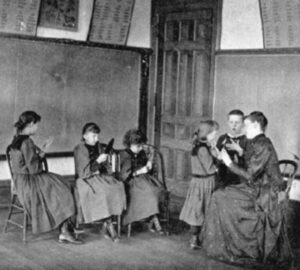
Teachers at the Illinois Institution for the Education of the Deaf and Dumb train students to enunciate and speak vocally. This oralist practice, emerging after the Civil War, seeks to assimilate Deaf individuals into hegemonic white hearing norms; marginalizing American Sign Language and Deaf culture while reinforcing hearing behaviors as the standard.
Keywords
Education, Oralism, Assimilation
Sources
Christopher Krentz, “A Sense of Two-ness: Deaf Double Consciousness at Midcentury,” in Writing Deafness (Chapel Hill: University of North Carolina Press, 2007), 131-169, 135.
Deaf Students at Gallaudet College
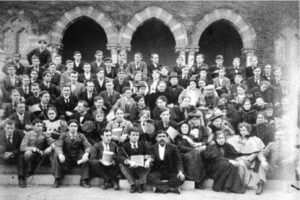
Students at Gallaudet College, the first for Deaf individuals, challenge the Oralist movement by asserting their identity. This photograph marks a pivotal moment in Deaf culture, highlighting their fight for education, dignity, and cultural pride against imposed white, hearing-centric norms.
Keywords
Culture, Movement, Education
Sources
Christopher Krentz, “A Sense of Two-ness: Deaf Double Consciousness at Midcentury,” in Writing Deafness (Chapel Hill: University of North Carolina Press, 2007), 131-169, 157.
Verdict in the Plessy V. Ferguson Case
The Supreme Court rules against Plessy’s, who is ⅛ Black, claim that his refusal to move from white seating violates the 13th and 14th amendment. This ruling enforces the ideas of “separate but equal” and racial segregation in the US: showing racism’s prevalence in American culture. This ruling perpetuates inferior education and facilities along with poor treatment for Black citizens
Keywords
Segregation, “separate but equal”, Racism
Sources
Brian Duignan, “Plessy v. Ferguson,” Encyclopedia Britannica, (December 17, 2024). https://www.britannica.com/event/Plessy-v-Ferguson-1896
Deaf Philosopher Argues Against Oralism
Douglas Tilden’s Reflections, published in the deaf newspaper The Silent Worker, displays both his and the newspaper’s opposition to the oralist movement, which has grown in popularity in recent decades. Tilden demonstrates a reluctance to abandon sign language and a skepticism of oralist Institutions for the Deaf. His beliefs are representative of a broader belief that assimilation to a hearing world limits the potential for deaf people to succeed and build community.
Keywords
Douglas Tilden, The Silent Worker, oralism, sign language, Institutions, assimilation, deaf community
Sources
Douglas Tilden, “Reflections of a Deaf-Mute Philosopher,” in Deaf American Prose, p. 122-5.
Tilden Publishes “Reflection of a Deaf-Mute Philosopher”
Douglas Tilden critiques on deaf people, their lives, and their interactions with hearing people in America by publishing his work, encouraging the integration of the deaf and hearing communities.
Keywords
Community Forming, assimilation, Douglas Tilden
Sources
Douglas Tilden, “Reflections of a Deaf-Mute Philosopher”, Deaf American Prose, 122-125.
Black Skin, White Masks by Frantz Fanon
Parallel to the deaf community is the dynamic between black Algerians under French colonial rule. The “whiter” the Algerians are, the more “human”, this “white-ness” came in the form of speaking the French language. Mirroring the oralist movement, seeking to assimilate the deaf by banning sign, and teaching them to speak. Morphing their identity to follow the norms of the hearing society. Destroying the community, by taking away the ability to communicate with each other.
Keywords
French colonialism, oralism movement, language
Sources
Christopher Krentz, “A Sense of Two-ness: Deaf Double Consciousness at Midcentury,” in Writing Deafness (Chapel Hill: University of North Carolina Press, 2007), 134.