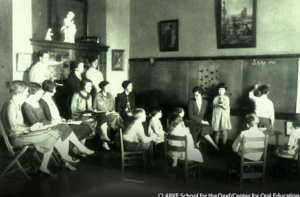
Caroline Yale, principal of Clarke, initiated a teaching program for hearing individuals, 97% of whom were women. These women serve as role models for Deaf children and promote their assimilation into a hearing world through their “feminine” characteristics. This program uplifts women amid oppression, yet further marginalizes the Deaf community, especially Deaf women.
Gender, Women, hearing, Deaf teachers, Deaf educators, Clarke Institution for the Deaf-Mutes, Northampton
Burch, “The Irony of Acculturation,” Signs of Resistance, 17-19.
Image: “Women in the Classroom: After the Civil War.” Gallaudet University. Accessed January 14, 2025. https://gallaudet.edu/museum/exhibits/history-through-deaf-eyes/language-and-identity/women-in-the-classroom-after-the-civil-war/.
Deaf Catholics create a vital platform. The community resists oralist subversion and advocates sign language’s cultural and spiritual importance. The publication empowers the community’s self-determination, continues educational access, and celebrates Deaf identity against an assimilating narrative.
Deaf, platform, self-determination, assimilating
Burch, Susan. “2. Visibly Different: Sign Language and the Deaf Community” In Signs of Resistance: American Deaf Cultural History, 1900 to World War II, 42-66. New York, USA: New York University Press, 2002. https://doi.org/10.18574/nyu/9780814789988.003.0007
The Society for the Welfare of Jewish Deaf People (SWJP) and the newspaper association The Jewish Deaf advocate for the rights and needs of Jewish Deaf individuals. The Jewish Deaf community challenged audism through their roles as leaders and educational accomplishments. The celebration of Jewish individuals in the deaf community stands in stark contrast to their position in American society.
anti-semitism, deaf advocacy, deaf history, audism, New York, Philadelphia
Burch, Susan. Signs of Resilience. Accessed January 14, 2025, page 49 and 50
The congregation supports the Jewish Deaf community, fostering a stronger sense of belonging after years of discrimination. It partners with hearing organizations to establish the Society for the Welfare of the Jewish Deaf, creating a network for connection and support. It becomes a hub for Jewish Deaf immigrants, organizing events, offering services, and building a vibrant community. Later renamed the New York Society of the Deaf.
Community, Congregation, Judaism, Immigrants
Burch, Susan. “2. Visibly Different.” De Gruyter, New York University Press, 1 Nov. 2002, www.degruyter.com/document/doi/10.18574/nyu/9780814789988.003.0007/html.
Long, deaf educator and Gallaudet College graduate, publishes the first sign dictionary in Washington, D.C. He intends the manual to strengthen communication between signing and non-signing teachers and their Deaf students. Long believes it clear that signing fosters a closer student-teacher relationship. With his manual, he hopes to preserve the language’s beauty and promote signing uniformity nationwide.
deaf education, language preservation, uniformity, communication
Susan Burch, “Visibly Different: Sign Language and the Deaf Community” in Signs of Resistance (New York: New York University Press, 2020), 55.
J. Schuyler Long, The Sign Language: A Manual of Signs (Washington, D.C.: Press of Gibson Bros., 1910), 5-6.

Deaf educator J.S. Long publishes a sign language dictionary. Long used new technology–photography–to capture visual communication, accompanied by text explanations. Preserving, codifying, and disseminating Sign Language, Long’s dictionary resisted oralism’s rise. Sign dictionaries empower deaf people, fostering linguistic proficiency and cultural connections.
J. Schuyler Long; dictionary; empowerment; language standardization
Burch, Susan. “Visibly Different: Sign Language and the Deaf Community.” Essay. In Signs of Resistance: American Deaf Cultural History, 1900 to World War II, 53–56. New York University Press, 2004.

Sign language in deaf schools is helping mental development. However, oralism is on the rise. NAD leader George Veditz releases films to preserve sign language. The number of remaining master signers is limited. The NAD films master signers to preserve their craft. Film also is helping deaf individuals express and protect their ideas and values. Through protecting sign language, less deaf individuals’ are being forced to assimilate to modern society.
George Veditz, Oralism, Master Signer, Assimilation, Community, Language, NAD(National Association of the Deaf)
Readings:
American Deaf Cultural History, 1900 to World War II, New York, USA: New York University Press, 2002, pp. 46-65.
Edward Miner Gallaudet, “Must the Sign Language Go?” American Annals of the Deaf (1899), pp. 228
Picture:
American Deaf Cultural History, 1900 to World War II, New York, USA: New York University Press, 2002, pp. 54
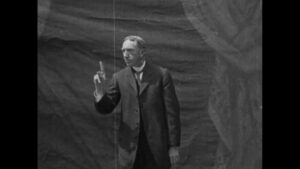
Veditz gives a speech to attendees of the NAD convention in Colorado Springs. He calls for the preservation of sign language. This speech proposes to film the master signers for the education of future deaf generations. This speech is the first to be filmed and produced in 1913. This speech is a vital start to the movement for preservation of sign language through film.
ASL; master signers; film; preservation; Veditz
“History.” Georgia Association of the Deaf, September 2, 2024.
Susan Burch, Signs of Resistance: Visibly Different (New York: New York University Press, 2002), pp. 57-58
Jewish deafs advocate for their own congregation in New York. They have felt outcasted by mainstream society. The hearing world shows support by merging to create the SWJD. Ministry work reaps literacy and welfare programs. Deafs feel accepted by religion as it acknowledges intersectional populations. With a newfound confidence, SWJD encourages Deaf generations to come and find solidarity in their community.
Jewish, Deaf, Outcast, Advocate, Acceptance, Culture, Intersectionality
Burch, “Visibly Different: Sign language and the deaf community,”’ Signs of Resistance.
In the NAD produced film, one time president George Veditz expresses the beauty of sign language over oralism. Honoring sign language’s cultural heritage by historical sign masters, Veditz suggests moving picture films to preserve and pass ASL. This advocacy anchors the nationwide movement of recording and producing signed films for both future ASL educational purposes and community bonding.
National Association of the Deaf (NAD), George Venditz, sign language, oralism, preservation, signed films, education, community
The National Association of the Deaf (NAD). “The Preservation of Sign Language by George W. Veditz.” https://www.youtube.com/watch?v=XITbj3NTLUQ.
Susan Burch, “Visibly Different: Sign language and the deaf community,” Signs of Resistance. P. 57.
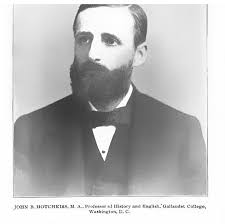
Renowned Gallaudet educator, John Burton Hotchkiss, details the establishment of the first school for the deaf in Hartford, Connecticut. Hotchkiss moves viewers. He powerfully describes Laurent Clerc’s clothing and mannerisms to convey his status as a hero. This film, representing technological innovation, preserves sign language for future generations and exhibits the centrality of education in the deaf community.
John Burton Hotchkiss, ASD, Laurent Clerc, Film
Burch, “Visibly Different: Sign language and the deaf community,”’ Signs of Resistance (58).
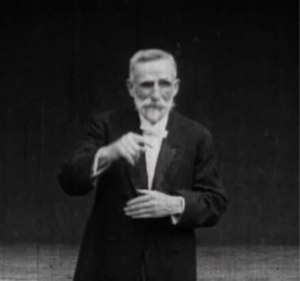
In a film produced by the National Association for the Deaf, Hotchkiss reflects on his connection with deaf leader Laurent Clerc. Through masterful signing and personal anecdotes, Hotchkiss connects generations, bringing deaf individuals closer to the foundational culture of Clerc’s teachings. These films preserve deaf history. They demonstrate the values of the deaf community to the world. This carries out the NAD’s visions to preserve the legacy of sign language for future generations.
NAD, Film, Signing, Clerc, Hotchkiss, preservation, ASD
Burch, S. (2002). 2. Visibly Different: Sign Language and the Deaf Community. In Signs of Resistance: American Deaf Cultural History, 1900 to World War II (pp. 58). New York, USA: New York University Press. https://doi.org/10.18574/nyu/9780814789988.003.0007
Deaf history transforms. Perception grows, as attendance rises. Hearing communities faith diminishes. Churches serve communities as cultural sanctuaries. Generations honor heritage and sign language unites. Spiritual participation builds more deaf schools. Missionaries amplify God’s words through community efforts. Faith strengthens, preserves and unites cultural identity.
Religion, Influence, Catholicism, Community
Burch, Susan. “ ‘Visibly Different: Sign Language and the Deaf Community’ .” Signs of Resistance, New York University Press, 2002, pp. 42–66.
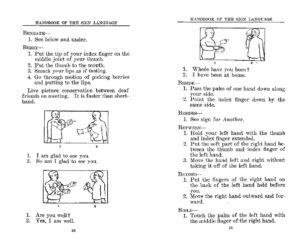
J.W. Michael, missionary for the deaf community, publishes this to protect sign language against oralism: showing the importance of language to deaf culture. He writes this dictionary to educate seminary students, who will help the deaf community. The dictionary illuminates the validity of sign language and the work of the elite deaf community to preserve “the beautiful Sign Language”.
Image Caption:
This picture illustrates the handbooks’s instructional content: both images and word description. The Home Mission Board Southern Baptist Convention publishes this in 1923. The use of both words and images allows accessibility to learners – critical to the deaf community.
Sign Language, Communication, Oralism, Community, Instruction, Education
Susan Burch, “Visibly Different: Sign Language and the Deaf Community”. Signs of Resistance:American Deaf Cultural History, 1900 to World War II. (New York, USA: New York University Press, 2002). 55-56.
J. W. Michaels, “Handbook of the Sign Language of the Deaf” (Atlanta, Georgia: Gallaudet University, 1923)
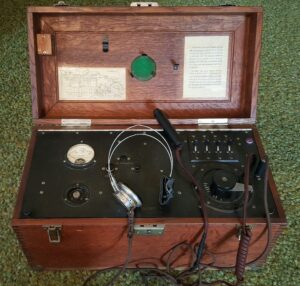
An audiometer tests the extent of hearing based on tonal frequencies (pictured here). Rudolph Pinter, Herbert Day, and Irving Fisfield, educational specialists, research the speech abilities of residential and oralist day school students using audiometers. The study concludes that the age of deafness, degree of hearing loss, and length of speech training affect speech abilities. The data showcases the limitations of oralism; however, many oralism supporters ignore these conclusions.
scientific discovery, audiometer, education, oralism
Burch, Susan. “The Irony of Acculturation,” Signs of Resistance, (New York University Press, 2002), 7-41. Pg 33.
As the Georgia Association for the Deaf successfully ousts the state school’s oralist administrator, deaf students show greater academic progress using a combined teaching method than they had using only oralist methods. This change is one example of a national shift towards a combined teaching method for deaf children. The deaf community’s commitment to securing sign language as part of their cultural heritage prevents deaf culture from being assimilated into the mainstream.
GAD, 1930s, assimilation, resistance, oralism, combined teaching method, mainstream, education
Susan Burch, “The Irony of Acculturation,” in Signs of Resistance, 30
GLAD addresses barriers by providing training, services, and advocacy. The organization empowers individuals in its activities amidst a changing generation marked by social tensions as new gen Deafs went from clubs to dinner-parties in the 1960s. GLAD’s efforts reflect a shift towards systemic activism. The organization helps pioneer new Deaf spaces.
social tensions, deaf clubs, aspirations
Carol A. Padden and Tom L. Humphries, Inside Deaf Culture (Cambridge, MA: Harvard University Press, 2005), 87-99.
Naming a football field after the Hotchkiss demonstrates his students’ affections towards him. Such an honor implies that Hotchkiss impacted his students greatly. Through his stellar teaching and coaching Hotchkiss cultivates a tight community through education that is proven by naming the field after him.
John Burton Hotchkiss, Gallaudet, Athletics, Football, Community
Burch “Visibly Different:Sign Language and the deaf community” Signs of Resistance.