Employment and Labor [final project]
Deaf Inclusion in the Workplace during the Rise of American Industrialism
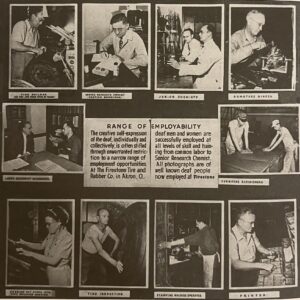
Deaf individuals face workplace exclusion. Despite the growing demand for labor, many deaf workers are denied high-quality jobs, with hearing employers holding most power. Deaf leaders push for reform, but their focus remains on individual efforts rather than collective action. The shift from rural artisan work to urban factory settings leaves deaf workers vulnerable, and while some find employment, the fight for fair treatment continues to challenge their progress.
Photo caption:
Many people assume Deaf Individuals can not pursue certain careers. This photo exemplifies successful Deaf citizens obtaining careers in a multitude of different complex and difficult fields. Deaf opportunities are not limited–regardless of what some may falsely believe.
Keywords
Workplace, Society, Employment, Industrialism, Oppurtunity
Sources
“An Address, Written by Mr. Clerc, and Read by His Request at a Public Examination of the Pupils in the Connecticut Asylum before the Governour and Both Houses of the Legislature, 28th May 1818.” Accessed 26 Jan. 2025. pp.14
Buchanan, Robert M. Illusions of Equality: Deaf Americans in School and Factory, 1850-1950. Gallaudet University Press, 2012. Pp. 9, 10, 12
“The 19th Century.” Encyclopædia Britannica, Encyclopædia Britannica, inc., www.britannica.com/science/deaf-history/The-19th-century. Accessed 26 Jan. 2025.
Photo:
Buchanan, Robert M. Illusions of Equality: Deaf Americans in School and Factory, 1850-1950. Gallaudet University Press, 2012. Pp. 110
Deaf Leaders in Nearly a Dozen States Across the Country, Establish Labor Bureaus to Assist the Deaf
Labor bureaus were formed, first in Minnesota, to combat discrimination against Deaf workers in the workplace. Educating the public about their talents and connecting them with willing employers. Despite these efforts, employers often refused to hire Deaf individuals due to communication barriers and prejudice. Deaf leaders hoped the bureau would expand opportunities. However, limited funding and influence hindered significant progress, leaving many Deaf workers still unemployed.
Keywords
Employment, barriers, bureaus, funding, discrimination
Sources
- Buchanan, Robert. “Labor Bureaus for The Deaf.” Encyclopedia of American Disability History, edited by Susan Burch, Facts on File, 2009, p. 544. Facts on File Library of American History. Gale eBooks, link.gale.com/apps/doc/CX1698300421/GVRL?u=vol_m58c&sid=bookmark-GVRL&xid=c686a230. Accessed 21 Jan. 2025.
- Buchanan, Robert M. Illusions of Equality: Deaf Americans in School and Factory, 1850-1950. Gallaudet University Press, 1999.
- Schein, Jerome Daniel, and Marcus T. Delk. The Deaf Population of the United States. National Association of the Deaf, 1974.
Marlee Matlin accepts the Academy award for Best Actress in Children of a Lesser God

Matlin’s Oscar speech follows a familiar structure but stands out for being in sign. As the first deaf person to win an Academy Award, her victory shatters stereotypes of deaf women in film and inspires the deaf community. By breaking into a hearing-dominated industry, she opens doors for greater representation. The traditional tone of her speech highlights how deaf individuals utilize respectability politics to gain opportunities for employment and social mobility.
Image Caption: : Marlee Maitlin in a purple dress, with hair tied up with white flowers smiles brightly. She is holding her freshly won Oscar in one hand, and presenting the ASL sign for I love you in the other.
Keywords
Actress, Employment, Oscar, Maitlin, Cinema
Sources
Hott, L.R. (2007). Creating the History through Deaf Eyes Documentary. Sign Language Studies 7(2), 135-140. https://dx.doi.org/10.1353/sls.2007.0005.
Through Deaf Eyes. (n.d.). [Video recording]. Retrieved January 23, 2025, from
Burch, Susan. “Matlin, Marlee (1965-).” Encyclopedia of American Disability History, edited by Susan Burch, Facts on File, 2009, pp. 595-596. Facts on File Library of American History. Gale eBooks, link.gale.com/apps/doc/CX1698300458/GVRL?u=vol_m58c&sid=bookmark-GVRL&xid=fea642a8. Accessed 24 Jan. 2025.
https://www.youtube.com/watch?v=2y4K_Xc7-JU
https://people.com/marlee-matlin-reveals-what-william-hurt-said-to-her-in-limo-after-her-oscar-win-i-was-stunned-8422184