Language, Communication, and Words
Melchor de Yebra of Spain and the First Documented "Hand Alphabet"
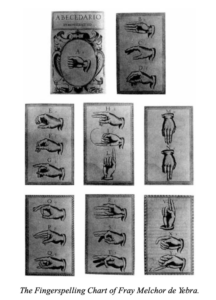
Fray Melchor de Yebra adapts a Catholic hand alphabet to communicate with deaf individuals. His efforts marks an early step toward deaf education. Yebra’s purpose is to allow missionaries to teach to the deaf about God. His work is part of the foundation for future global educational practices for the deaf.
Keywords
hand alphabet, foundation, communication
Sources
Van Cleve, John Vickrey, and Barry A. Crouch. “To Educate a Deaf Person.” In A Place of Their Own: Creating the Deaf Community in America, 10–20. Gallaudet University Press, 1989. https://doi.org/10.2307/j. v2rh2bhz.6.
1656—Anthony Deusing Publishes The Deaf and Dumb Man’s Discourse in Holland
In the book, Deusing suggests that the deaf are capable of learning and communicating through signing. The idea that deaf people are teachable revolutionizes deaf culture, as people start to realize their capabilities. This idea spreads from Europe to America which is the beginning of American deaf culture, starting with education.
Keywords
Education, Signing, communication
Sources
John Van Cleve and Barry Crouch, “To Educate A Deaf Person,” In A Place of Their Own
The Deaf and Dumb Man's Discourse
In Holland, Anthony Deusing publishes The Deaf and Dumb Man’s Discourse. Observing deaf people communicating, Deusing argues that sign language can fully convey thoughts. His influential book challenged oralist advocates who believed signing should not be used in deaf education.
Keywords
communication, deaf education, sign language, methods debate
Sources
Van Cleve, John V., and Barry Crouch. “To Educate a Deaf Person.” In A Place of Their Own. Washington, D.C.: Gallaudet University Press, 1989, pp. 10–20.
John Harrower and John Edge, the First Instance of Deaf Education on U.S. Soil
John Harrower, an indentured servant, begins tutoring his contractor’s son. His diary marks the earliest record in colonial America to educate a deaf individual. Harrower’s entries highlight the lack of formal education for deaf children at the time and the struggle for inclusion and accessibility during America’s formative years.
Keywords
education, accessibility, inclusion
Sources
Van Cleve, John Vickrey, and Barry A. Crouch. “To Educate a Deaf Person.” In A Place of Their Own: Creating the Deaf Community in America, 10–20. Gallaudet University Press, 1989. https://doi.org/10.2307/j. v2rh2bhz.6.
1774—John Harrower Educates John Edge in America
John Harrower, an indentured servant educates a deaf boy John Edge. This is the first instance of deaf education in America. This is revolutionary for deaf culture as it is the start of education which plays a major role in deaf culture, allowing the deaf to have agency.
Keywords
America, education, communication
Sources
John Van Cleve and Barry Crouch, “To Educate A Deaf Person,” In A Place of Their Own
Declaration of Independance

The United States declares independence from Great Britain, which changes the global climate economically and politically, as the United states builds a new country establishing foundations for government and even education.
Keywords
Independence, America, Britain
Sources
Declaration of Independence 1776
Minority Groups have Disadvantages

Members of minority groups are having difficult times achieving success. Some social systems do not allow for the full participation of minorities: for example, the workplace. Henry White works towards proving deaf individuals can communicate just as effectively as speaking individuals in the workplace. Regardless of evidence, many still believe deaf people’s communication skills are lesser. Henry’s efforts are met with no reward. Deaf individuals are barred from jobs such as teachers or working in the government.
Keywords
Minority, workplace, communication, society
Sources
readings:
Robert Buchanan, “Chapter 2: Our Claims to Justice,” Illusions of Equality. P. 21, 32, 36
“Minority.” Encyclopædia Britannica, Encyclopædia Britannica, inc., 27 Nov. 2024, www.britannica.com/topic/minority. Accessed 6 Jan 2025.
Photo:
https://www.utahdeafhistory.com/uploads/5/4/2/6/5426987/henry_c._white_theutaheagle_feb1922.pdf
Laurent Clerc’s address for the First American School for the Deaf in 1818
Laurent Clerc advocates for the first deaf school in America. He addresses stakeholders for the Hartford school at Connecticut in a pivotal first impression. Clerc ushers their support, describing how sign language is more effective. He builds this school as a pioneer to uplift the deaf and their self-determination.
Keywords
pioneering, first impression, advocates
Sources
Laurent Clerc. An Address, Written by Mr. Clerc, and Read by His Request at a Public Examination of the Pupils in the Connecticut Asylum Before the Governour and Both Houses of the Legislature, 28th May 1818. Hartford: Hudson and Co., 1818.
Laurent Clerc’s address for the First American School for the Deaf

Laurent Clerc’s speech to investors details deaf education’s importance. Education enables deaf people. He emphasizes the importance of oralism and manualism.
Keywords
Laurent Clerc, Oralism, Manualism, Deaf education, Foundation
Sources
An address written by Mr. Clerc, and read by his request at a public examination of the pupils in the Connecticut Asylum before the governour and both sides of the Legislature, 28th of May 1818
Charles Darwin’s Origin of Species publication becomes a source for the oralist generation to abuse

English naturalist Charles Darwin introduces the theory of evolution. He shares how sign language is a “primitive and infant way of thinking”. As a result, assimilation occurred in schools – banning signs. Thus, teaching deaf children to speak and lip-read. This reflects the evolutionary biases held by those with greater societal status.
Keywords
Evolution, Primitive, Banned, Oralist, Assimilation, Biases
Sources
Douglas Baynton, “Savages and Deaf-Mutes: Evolutionary Theory and the Campaign against Sign Language,” Journal Anthropological Study of Human Movement 8, no. 4 (1995): 139-72
Education Debate

Whether teaching deaf students oral communication skills or sign language is under hot debate. Oralists argue teaching deaf individuals skills such as lip reading or speech is necessary while manualists argue sign language should be taught. Oral methods are currently seen as more useful while sign language is seen as obsolete in modern society. Many of these education choices are made without regard to the wants of the deaf students themselves.
Keywords
Oralist, Manualist, communication, language
Sources
Reading:
Robert Buchanan, “Chapter 2: Our Claims to Justice,” Illusions of Equality. P. 20, 21
photo:
https://gallaudet.edu/museum/exhibits/history-through-deaf-eyes/language-and-identity/language-and-identity-in-the-1800s-deaf-students-denied-use-of-sign-language/
Rise of Oralism Leads to Deaf Schools Banning Sign Language
The simultaneous rise of oralism and Evolutionary Theory in the late 19th century leads to the widespread ban of sign language in Deaf schools. Oralists attempt to erase Deaf culture by “civilizing” Deaf individuals, forcing them to use lip-reading and speech. However, this applies mainly to white Deaf American students, revealing the racist ideologies of the time.
Keywords
oralism, Evolutionary Theory, deaf students, racism
Sources
Douglas Baynton, Savages and Deaf-Mutes: Evolutionary Theory and the Campaign Against Sign Language, 141;163.
American Civil War
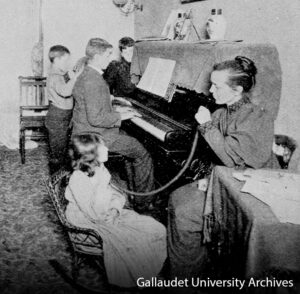
While sign language expands throughout the 1850s, oralists also increase their efforts to make the deaf education system oral-based following the Civil War. From the 1860s forward, oralists prioritize notions of “full participation” in society for deaf people rather than accepting the viability of sign language.
Keywords
Sign language, oralism
Sources
Robert Buchanan, “Chapter 2: Our Claims to Justice,” Illusions of Equality (22-23).
From Histories of American Schools for the Deaf, 1817-1893, ed. Edward Allen Fay (Washington, D.C, Volta Bureau). Gallaudet University Archives
James Denison Attends the Milan Convention
James Denison, a Deaf educator, publishes his observations of the Milan Convention in the American Annals of the Deaf. According to Denison, Abbe Tarra, the solemn and deeply religious conference president, supports oralism. Tarra argues that sign language is inadequate for complex religious ideas. Denison uniquely disagrees. Denison, a manualist, argues that signing bridges language barriers. He believes Italy’s success in oralism stems from teacher-to-student ratios rather than oralism itself.
Keywords
oralism, manualism, Milan Convention
Sources
James Denison, “Impressions of the Milan Convention,” American Annals of the Deaf 26, no. 1 (January 1881), 81-83.
Oralism Over Sign Language: Milan Convention
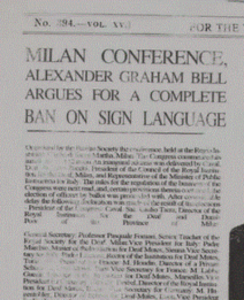
James Denison attends the convention led by religious leaders who ban sign language. They argued speech is necessary for sharing the Word of God. This decision limits communication access for deaf children. Pushing for oral education is a savior complex on their part. The consensus is that sign is not complex or intellectual.
Image Caption: Published on a newspaper, in bold large letters, it states: “MILAN CONFERENCE, ALEXANDER GRAHAM BELL ARGUES FOR A COMPLETE BAN OF SIGN LANGUAGE.” This documentation is telling of itself, as it is printed and preserved. This conveys the turning point of American Deaf history and the erasure of Deaf culture.
Keywords
Oral, Convention, Education, Limit, Access, Complex
Sources
James Dennison, “Impressions of the Milan Convention,” (1881), in Deaf American Prose, p. 81-83.
Alexander Graham Bell's Speech to the National Academy of Science
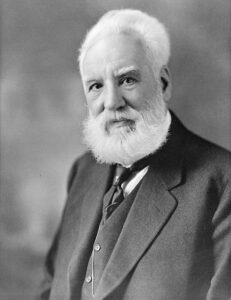
Bell argues that residential schools separate deaf people from the rest of American society. He claims that the practices of residential schools, especially the use of sign language, set deaf people apart as defective and other. Bell and other oralists thus advocate for the closing of residential schools and the prevention of sign language in order to limit the impact of deafness on deaf individuals’ daily lives.
Keywords
Alexander Graham Bell, residential schools, sign language, oralism
Sources
Robert Buchanan, “Chapter 2: Our Claims to Justice,” Illusions of Equality (20).
Oralism is reconsidered

Profound leader in the deaf community, Edward Gallaudet, reconsiders the best way to communicate with deaf students. Gallaudet knows education helps students find their place in American society. However, he disagrees with deaf students being taught exclusively orally. Oralism aids education. However, spoken information is often not interpreted properly by deaf students. As the flaws of oralism begin to reveal themselves, the most effective education style for Deaf Students is reconsidered.
Keywords
Oralism, Community, Communication, Education, Society
Sources
Reading:
Edward Miner Gallaudet, “Must the Sign Language Go?” American Annals of the Deaf (1899). p. 221-228
Picture:
https://www.loc.gov/resource/cwpbh.04009/
Evolutionary Theory Becomes Widespread in the U.S.
Charles Darwin introduces Evolutionary Theory in On the Origin of Species (1859), but it does not gain widespread acceptance in the U.S. until the late 1800s. John M. Tyler’s 1899 keynote address reflects this shift. Evolutionary Theory influences deaf education, psychology, criminology, social policy, and religious thought. Oralists of the time believed that sign language was ‘primitive’ and showed societal ‘regression’.
Keywords
Evolutionary Theory, oralism, cultural shift
Sources
Douglas Baynton, Savages and Deaf-Mutes: Evolutionary Theory and the Campaign Against Sign Language, 139-141.
Edward Miner Gallaudet Publishes “Must the Sign Language Go?” in American Annals of the Deaf
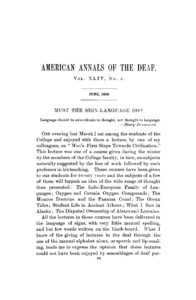
Edward M. Gallaudet believes sign language should be kept in schools. He acknowledges oralists’ qualms about excessive signing. Oralism lacks precision. Sign language aids deaf children’s mental development. Sign language’s removal from deaf schools would be detrimental.
Keywords
Edward M. Gallaudet, CODA, Sign Language, Oralism, Manualism, Communication
Sources
Edward Miner Gallaudet, “Must the Sign Language Go?” American Annals of the Deaf (1899), 8.
The Great Migration of African Americans negatively affected deaf learning
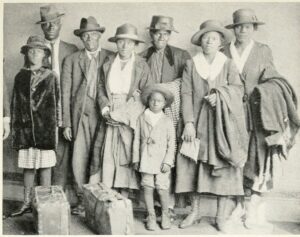
The Great Migration after World War I segregated African American and white deaf students. North Carolina established the first Black deaf school, setting an example for others. Segregation causes unfair conditions. Black teachers are paid less. Black students continue to sign while white students speak orally. Black Deafs endured educational and cultural disparities.
Keywords
Black, Segregation, Oralism, Sign, Disparities
Sources
Douglas Baynton, “Savages and Deaf-Mutes: Evolutionary Theory and the Campaign against Sign Language,” Journal Anthropological Study of Human Movement 8, no. 4 (1995): 152-154
Hill, J. (2020) Reflections on Black History Month by Dr. Joseph Hill, National Deaf Center. Available at: https://nationaldeafcenter.org/news-items/reflections-black-history-month-dr-joseph-hill/ (Accessed: 07 January 2025).