Artistic Expression Final Project
The Mute’s Lament: Bridging Perspectives
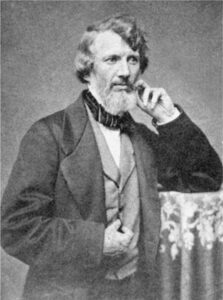
The poem conveys raw emotions and experiences of a deaf-mute. It invites hearing readers to step into their perspective. Vivid imagery immerses readers in the world of the deaf. John Carlin’s writing acts as a bridge between communities. It challenges societal perceptions and encourages shifts in viewpoints. The poem highlights the intellectual potential of deaf individuals. It fosters empathy and understanding through powerful, descriptive, and emotional poetry.
Image description:
A black and white image of the Deaf artist John Carlin, taken in the year 1845 a couple of years prior publishing his famous poem, “The Mute’s Lament.” He is photographed while looking away, portraying a pensive face. With one hand on his right cheek, while the other one is tucked nicely close to his body. Also, the hairstyle plus his formal attire also demonstrates the importance of the situation and place where the picture was taken.
Keywords
Expression, Silence, Longing
Sources
Carlin, John. “The Mute’s Lament.” American Annals of the Deaf, Gallaudet University Press, 14 July 2022, muse.jhu.edu/pub/18/article/860050/pdf.
“Chronology.” Encyclopedia of American Disability History, edited by Susan Burch, Facts on File, 2009, pp. xxiv-lvi. Facts on File Library of American History. Gale eBooks, link.gale.com/apps/doc/CX1698300012/GVRL?u=vol_m58c&sid=bookmark-GVRL&xid=4b4987a8. Accessed 28 Jan. 2025.
Gallaudet U Press. “Introduction.” Gup Digital Books, gallaudetupress.manifoldapp.org/read/a-mighty-change-an-anthology-of-deaf-american-writing-1816-1864/section/e197a314-db99-4319-a79b-61f7c42707ea. Accessed 28 Jan. 2025.
Image source:
Gallaudet U Press. “A Mighty Change: An Anthology of Deaf American Writing, 1816-1864.” Gup Digital Books, gallaudetupress.manifoldapp.org/read/a-mighty-change-an-anthology-of-deaf-american-writing-1816-1864/section/ef480432-bee4-4926-ad4b-f4707e07c903. Accessed 28 Jan. 2025.
Deaf Art Movement (DAM) at Gallaudet University
Ann Silver and Harry William co-found the Deaf Art Movement (DAM) with other art students, focusing on creating artwork centering ASL and the general Deaf experience. DAM begins politicizing Deaf art to be used as resistance against audist perspectives and lays the framework for future Deaf art activism.
Keywords
Deaf Art Movement, DAM, Deaf art, resistance, Deaf culture, ASL
Sources
Deaf Art. “Ann Silver.” Accessed January 29, 2025. https://deaf-art.org/profiles/ann-silver/.
Durr, Patti. “Art Genres and Movements.” In The SAGE Deaf Studies Encyclopedia, edited by , 40-42. Thousand Oaks, CA: SAGE Publications, Inc, 2016. https://doi.org/10.4135/9781483346489.
Silver, Ann. “My Experience as an Artist Vis-à-vis Deaf Art.” Visual Anthropology Review 15.2 (Fall 1999): 37-46.
Surdists United. “De’VIA Timeline.” Accessed January 29, 2025. https://surdistsunited.com/devia-history/devia-timeline/#:~:text=In%201972%20%E2%80%93%20Dr.,Tank%20for%20video%20and%20summary.
“The Silent World”: First American Deaf Art Exhibit at Gallaudet University in Washington, D.C.
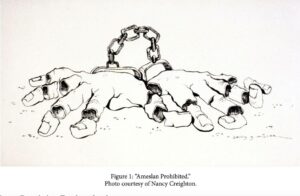
Deaf artist and educator Betty G. Miller presents the exhibit to illustrate oralism’s harm and celebrates ASL through resistance art. Inspired by the Deaf Art Movement and Civil Rights Movement, it highlights Deaf identity and oppression. This work paves the way for the De’VIA (Deaf View/Image Art) movement of the 1980s-1990s and bridges a gap between Deaf and non-Deaf audiences by using art to communicate Deaf wisdom.
Image Description: A black-and-white drawing featuring two large hands shackled at the wrists with chains. The fingers are broken at the fingertips, the fingertips removed from the rest of the hands. The fingers are also hollow. The background is white. The artwork critiques the suppression of American Sign Language (ASL) and the oppression of the Deaf community. It is signed by the artist in the bottom right corner (Betty G. Miller) with the date 1972.
Keywords
Art Resistance Activism Gallaudet University Betty G. Miller De’VIA DAM Oralism manualism
Sources
Conley, Pamela (2022) “50th Anniversary of “Ameslan Prohibited”: Celebrating Betty G. Miller’s Creativity,” Society for American Sign Language Journal: Vol. 6: No. 2, Article 7. https://tigerprints.clemson.edu/saslj/vol6/iss2/7.
Surdists United. “De’VIA Timeline.” Accessed January 29, 2025. https://surdistsunited.com/devia-history/devia-timeline/#:~:text=In%201972%20%E2%80%93%20Dr.,Tank%20for%20video%20and%20summary.
Deaf Art. “Betty G. Miller.” Accessed January 23, 2025. https://deaf-art.org/profiles/betty-g-miller/
Silver, Ann. “My Experience as an Artist Vis-à-vis Deaf Art.” Visual Anthropology Review 15.2 (Fall 1999): 37-46.
Durr, P. (1999), Deconstructing the Forced Assimilation of Deaf People via De’VIA Resistance and Affirmation Art. Visual Anthropology Review, 15: 47–68. doi:10.1525/var.2000.15.2.47
'Spectrum, Focus on Deaf Artists' Originates in Austin, Texas
Janette Norman, a hearing art teacher, co-founded Spectrum, a Deaf artists’ colony with funds from Helen DeVitt Jones. Deaf artists gather to build community and produce art focusing on Deaf world. Spectrum becomes a hub for theatre, film, visual art, literature, and dance. Though it predates De’VIA, many key figures, including Betty G. Miller and Chuck Baird, spend time at Spectrum. Their experiences there plant the seeds for what will become the De’VIA movement.
Keywords
Spectrum, Deaf communtiy, Deaf art, Deaf culture
Sources
De’VIA Curriculum Workgroup. “Spectrum (1975–1980s).” Accessed January 29, 2025. https://deviacurr.wordpress.com/devia-curr/devia-history-2/spectrum-1975-1980s/#:~:text=Spectrum%20was%20a%20Deaf%20artists,genre%20about%20the%20Deaf%20experience.
Durr, Patti. “Art Genres and Movements.” In The SAGE Deaf Studies Encyclopedia, edited by , 40-42. Thousand Oaks, CA: SAGE Publications, Inc, 2016. https://doi.org/10.4135/9781483346489.
The Groundbreaking Work, Activism, & Representation of Deaf Actress Marlee Matlin

In Children of a Lesser God, Matlin plays a Deaf woman who resists the erasure of her identity. While this film misrepresents Deaf world, Matlin champions authentic representation in Hollywood. She redefines Deaf representation. Her transformative activism shines in CODA (2021), where she stars and produces, ensuring accurate portrayals of Deaf experiences. CODA won 3 Oscars, setting a new standard for deaf representation in film. Her work confronts Hollywood’s history of audism.
Audism: The discriminatory belief that living in a hearing world is better than living in a deaf world. Deafness is inferior.
Image Description: Marlee Matlin, radiant in a purple evening gown, is beaming with pride. Her smile is infectious. This photo was taken at the 1987 Oscar ceremony. Her hair is elegantly styled in an updo with a hairpiece. She is also wearing silver earrings and glasses. In one hand, she is holding her Oscar. The other hand signs “I love you,” a heartfelt gesture directed to audience members and those in the deaf community. Matlin makes history this night, becoming the youngest actress to receive “Best Actress.” She receives this honor for her role in Children of a Lesser God.
Keywords
Marlee Matlin, Activism, Representation, Deaf Identity, Deaf Experience
Sources
Bibliography
Burch, Susan. “AMST Class Discussions.” Lecture, Middlebury, VT, January 27, 2025.
Children of a Lesser God. Directed by Randa Haines. 1986.
IMBd, ed. “CODA.” IMBd. Accessed January 28, 2025. https://www.imdb.com/title/tt10366460/?ref_=nm_flmg_knf_t_1.
Mandell, Andrea. “Marlee Matlin Reveals What William Hurt Said to Her in Limo After Her Oscar Win: ‘I Was Stunned.'” People. Last modified January 5, 2023. Accessed January 28, 2025. https://people.com/marlee-matlin-reveals-what-william-hurt-said-to-her-in-limo-after-her-oscar-win-i-was-stunned-8422184.
De’VIA Origination at Gallaudet University
Deaf artists and educators Betty Miller, known as the Mother of De’VIA, and Paul Johnston lead a four-day workshop where they create the De’VIA (Deaf View/Image Art) Manifesto. They define De’VIA as art that reflects Deaf experiences and culture, challenging stereotypes and hearing-centered narratives. Through newly politicized Deaf art, De’VIA becomes a powerful tool still used today for expression and activism, inspiring Deaf artists to celebrate their culture, resist oppression, and strengthen their community.
Keywords
De'VIA, Deaf art, resistance
Sources
Durr, Patti. “Art Genres and Movements.” In The SAGE Deaf Studies Encyclopedia, edited by , 40-42. Thousand Oaks, CA: SAGE Publications, Inc, 2016. https://doi.org/10.4135/9781483346489.
Museum of Deaf. “De’VIA (Deaf View/Image Art).” Accessed January 29, 2025. https://www.museumofdeaf.org/exhibits-3/de’via#:~:text=Deaf%20View/Image%20Art%2C%20also,of%20Affirmation%2C%20Resistance%2C%20and%20Liberation.
Surdists United. “De’VIA Manifesto.” Accessed January 29, 2025. https://surdistsunited.com/devia-history/devia-manifesto/.
Surdists United. “De’VIA Timeline.” Accessed January 29, 2025. https://surdistsunited.com/devia-history/devia-timeline/#:~:text=In%201972%20%E2%80%93%20Dr.,Tank%20for%20video%20and%20summary.