Movements, reforms, activism [final project]
First National Convention of Deaf-Mutes Meets to Discuss Improvement of the Deaf Class in Cincinnati, Ohio Leading to the Start of the NAD
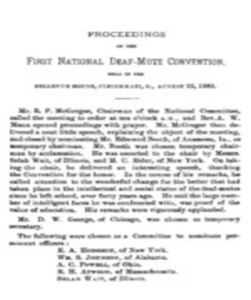
The convention, chaired by Edmund Booth, focuses on reforming vocational education and establishing religious affiliation to show the capability of the “deaf class”- a pivotal change in deaf history as this is the start of the National Association of the Deaf. Deaf community’s desire to be viewed as productive American citizens of a high class is illuminated. The NAD continues spearheading movements to improve the deaf community’s class level through the next two decades.
Image Description: The image above shows the printed proceedings of the First National Convention of Deaf-Mutes in 1880. The fact that it was printed shows members’ desire to memorialize the proposed education and religious reforms, illuminating this movement’s importance to the Deaf community.
Keywords
Movement, Capability, Deaf, National Association of the Deaf, Education
Sources
National Association of the Deaf. Proceedings of the First National Convention of Deaf-Mutes, (New York: Printed at the New York Institution for the Deaf and Dumb, 1880). 10-38.
National Association of the Deaf. (n.d.), NAD History. National Association of the Deaf. https://www.nad.org/about-us/nad-history/
American Annals of the Deaf Publishes “War-Time Evolution of Employment Opportunities for the Deaf”
Benjamin Marshall Schowe, Chairman of the NAD’s Industrial Committee, publishes an article on deaf employment during WWII in the American Annals of the Deaf. The article argues that increased workplace equality is the culmination of years of agitation by deaf organizations and activists. Deaf workers’ good conduct, Schowe claims, establishes their place in the post-war workforce. This demonstrates pressure deaf elites and publishers exerted on deaf individuals to maintain respectability and advance the community goals.
Keywords
Benjamin Marshall Schowe, American Annals of the Deaf, NAD, World War II, activism, employment, respectability politics
Sources
Brown, Cathy. “Schowe, Benjamin Marshall, Sr. (1893–1979).” In Encyclopedia of American Disability History, edited by Susan Burch, 803-804. Facts on File Library of American History. New York, NY: Facts on File, 2009. Gale eBooks (accessed January 26, 2025). https://link.gale.com/apps/doc/CX1698300633/GVRL?u=vol_m58c&sid=bookmark-GVRL&xid=25a55c7b.
Patterson, Lindsey. “American Annals of The Deaf.” In Encyclopedia of American Disability History, edited by Susan Burch, 31. Facts on File Library of American History. New York, NY: Facts on File, 2009. Gale eBooks (accessed January 26, 2025). https://link.gale.com/apps/doc/CX1698300037/GVRL?u=vol_m58c&sid=bookmark-GVRL&xid=83961d7b.
Schowe, Ben M. “War-Time Evolution of Employment Opportunities for the Deaf.” American Annals of the Deaf 88, no. 2 (1943): 111–18. http://www.jstor.org/stable/44388402.
Protests begin against pediatric cochlear implantation
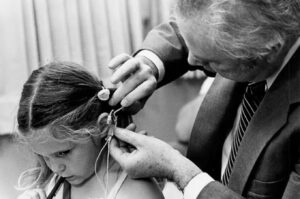
Marketed as a ‘cure’ despite deafness being neither a disease nor affliction, the deaf community forcefully opposes the procedure. Anxiety grows about the future of deaf culture if all deaf children receive CIs. Others argue CIs pose a bioethical issue. Children cannot consent to invasive surgery or lifelong dedication to speech and language development without guarantee of success. Deaf world offers equal education, culture, history, language, validation, and community.
Image Description: This black-and-white image depicts a young white girl with her head downturned to the left with a somber facial expression. Behind her left ear, a white man in a suit and tie fits her with a cochlear implant. The wires of the device travel through her hair and extend down to her side, highlighting the size and multiple pieces of the device that could potentially interfere with the life of a preschool-aged child.
Keywords
opposition, bioethics, deaf children, education, equality, technology, deaf culture
Sources
Christiansen, John B., and Irene W. Leigh. “Cochlear Implants.” Encyclopedia of American Disability History, edited by Susan Burch, Facts on File, 2009, pp. 192-194. Facts on File Library of American History. Gale eBooks, link.gale.com/apps/doc/CX1698300164/GVRL?u=vol_m58c&sid=bookmark-GVRL&xid=2818389c. Accessed 26 Jan. 2025.
Crouch, Robert A. “Letting the Deaf be Deaf Reconsidering the Use of Cochlear Implants in Prelingually Deaf Children.” In The Hastings Center Report 27, no. 4 (1977): 14-21. https://www.jstor.org/stable/3528774.
Routledge Handbook of Disability Studies, edited by Thomas, Carol, Alan Roulstone and Nick Watson. London, England: Routledge (Publisher), 2012. https://search-alexanderstreet-com.eu1.proxy.openathens.net/view/work/bibliographic_entity|bibliographic_details|3922970.