Spaces and Places [final project]
Formation of St. Ann’s Church for the Deaf
Rev. Thomas Gallaudet founds St. Ann’s Church for the Deaf in 1852, being the first church for deaf people. It allows deaf people to inclusively worship with hearing people. The church shows the hearing world that the deaf can be good citizens by worshipping god, destigmatizing deafness by allowing deaf people to emulate historical American values. The church also provides a physical space for the deaf to create religious communities without challenging communication barriers.
Keywords
St. Ann’s, Christianity, deaf churches, deaf spaces and places
Sources
“St. Ann’s Church for the Deaf.” Episcopal Diocese of New York,
dioceseny.org/ministries-to-the-deaf/st-anns/.
GALLAUDET, THOMAS. “ST. ANN’S CHURCH FOR DEAF-MUTES, NEW YORK.” American Annals of the Deaf and Dumb, vol. 11, no. 1, 1859, pp. 8–12. JSTOR, http://www.jstor.org/stable/45220629.
Formation of the National Black Deaf Advocates

Lottie Crook, Ernest Hairston, Williard Shorter, Linwood Smith, Charles Williams, and Elizabeth Wilson form the NBDA at a conference for black deaf advocacy. The organization defends black deaf communities’ agency. NBDA chapters provide accessible spaces for black deaf individuals to gather without language barriers, allowing for culture to prosper. The NBDA’S formation unites the black deaf community, a group that has historically been silenced in America.
Image Caption: This is the logo for the NBDA, depicting an outline of the United States with two fists and red, black, and green stripes. The image signifies that the NBDA has national goals of advocating for deaf and Black intersectionality.
Keywords
NBDA, intersectionality, deaf spaces and places
Sources
NBDA. “History – NBDA.” NBDA.org, 1982, www.nbda.org/history/.
Anderson, Glenn, and Lindsay Dunn. “Assessing Black Deaf History: 1980s to the Present.” Language Studies, vol. 17, no. 1, 2016, pp. 71–77, https://doi.org/10.2307/26189130.
Robert F. Panara presents his poem "NTID" during the inauguration of Dr. Albert Simone as President of the Rochester Institute of Technology
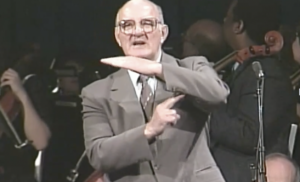
Deaf NTID Professor Robert Panara’s Poem speaks about the connection between the deaf and hearing communities at RIT through NTID. Having Panara speak at the inauguration shows how NTID is revered and included on campus. NTID is included at RIT. Historically, the deaf have been isolated in their education, but the NTID provides a deaf education space amongst a hearing community.
Image Caption: This is a screenshot from the recording of Panara’s speech where he is pictured in front of an orchestra on stage at the inauguration making the sign for “bridging.” This snapshot captures the essence of his poem, which speaks to bridging the gap between NTID and RIT.
Keywords
NTID, Robert F. Panara, RIT, inclusivity, integration, deaf spaces and places
Sources
Panara, Robert F. “NTID.” Rit.edu, 1982, digitalcollections.rit.edu/luna/servlet/detail/RIT~7~7~24~3921%3ANTID?utm_source.
“About NTID | National Technical Institute for the Deaf | RIT.” Www.rit.edu, www.rit.edu/ntid/about-ntidn .